
“I know less now than when I started” – Sabina Juniper Bonsai
Having cultivated, what I like to call bonsai, for close on forty years now I feel to some extent I know less now than when I started (so here it is written down). As a result I am increasingly reticent to share my thoughts. There’s just soooooo much information available right at our finger tips I figure the last thing the world needs is another knobhead spouting sage wisdom and I am really not interested in taking cheap shots from keyboard warriors. However it helps me a lot to get this stuff down and organise it in my head so please join me on a glorious summer ramble…..
I often spend significant chunks of my day on the telephone in deep discussion with folk who are often literally dazed and confused having spent copious time online trying to get answers to a seemingly innocent and simple question. In one case I literally had a lady on the phone crying in frustration. With everyone telling the poor girl something different she was in despair. Sadly this happens all the time because when you do not know something it’s hard to sort out what’s what. Just last week a lad was on the phone asking for soil because he had to do an ‘emergency repot’ what the feck ever that is.
His little bonsai was too wet and some knob advised him to repot pronto. I asked why the soil was to wet and he was sure it was because of a lack of drainage. Turns out he was watering by dunking every day and spraying the foliage too because that’s what he had been told one had to do with bonsai. My advice was if you don’t put so much water in there so often it won’t get so wet will it. Only water when dry, soak well when watering and then don’t do it again until it’s dry. Happy tree, happy fella and no sale for me. Dohh!
As an unrelated but illustrative example I remember a few years ago I had the misfortune to be in possession of a late 1990s V8 Jaguar. I love Jag’s and got my first XJ6 at age 19. However this late model X308 whilst not a bad example in itself was a good example of a car and in particular an engine built to a price. The last proper Jaguar cars, built by engineers and not bean counters rolled off the line in 1996 with the end of the AJ6/AJ16 platform and 1997 with the demise of the V12. I will never buy another Jag’ unless it’s an old one. Someone will argue with that opinion but this is my blog, my opinion, my experience and I don’t really care, i was just on my way to saying that, during my ownership of that beautiful but flawed vehicle I spent a lot of time on all sorts of websites and forums trying to get to the bottom of mostly infuriating electrical and mechanical problems.
I remember vividly one post that ended up running for seven very long pages. It was like a soap opera and wasted most of my Saturday morning reading it. Basically a guy bought a cheap XJ8, a repossession via an auction but could not get it to operate in anything other than limp home mode. Over months and at the behest of many random contributors the guy replaced everything on the car from simple electrical items to an eye-wateringly expensive ECU, coil packs, wiring, fuel system parts, the list just went on and on to no avail. Having spent several thousand pounds with no result whatsoever and in abject desperation he had the local Jaguar dealership pick up the car. It was a delight to read what happened next. He got a call 30 minutes after the car entered the workshop, all fixed! The bill was £40 plus the pickup (this was a while back). The fault? The repo guys picked it up off the owners driveway and took it away without the owner being present and had sent it to auction with a new key that had not been synched with the security system which took the dealer minutes to rectify.
The moral of the story? Be careful from whom you seek advice. Well meaning, helpful and nice people will try to assist but there really is no substitute for experience. I follow a vintage tools group on FB. Every day somebody posts an image of some obscure and unidentifiable object whilst everyone posts what they ‘think’ it might be. That’s as much use as a ventilated rain hat. If you really think a vintage mouse trap could in fact be some form of early Zippo just keep that to yourself along with your emergency repots. Bonsai is much the same although I don’t personally follow any of it online as it frustrates me too much so I stay away.
Assuming you are still with me this far I am going to set out a few lessons I have learned over ten or so years on the cultivation of Spanish yamadori sabina junipers. This information is entirely about Spanish examples that grow in my own garden here on the east coast of the UK. If you have other junipers, from different places and NOT grown in my precise conditions treat this as a general guide for your own work because every singe tree and every single garden will be unique. Much like the Jaguar above, the fix was simple but figuring out the issue to begin with was where the value of genuine hands on experience paid off. NEVER underestimate the ability of well meaning people to over-complicate a situation having got the wrong end of the stick, it’s just our nature.
Not everyone is keen on junipers. Personally I love them but have struggled sometimes. I believe a lot of my troubles are because I was mis-informed decades ago and unlearning that has been a task. My first contact with sabina juniper was over 25 years ago when I purchased a very poor, poorly and hideously overpriced example from an Italian collector. The tree was so weak and poorly even my best efforts over five years resulted in less than an inch growth and less foliage than when I started. After several years I took it out of the bucket, cleaned away every speck of soil only to find barely a literal teaspoon full of live root. I was subsequently reticent to get involved with any form of Sabina.<
Several years later I was introduced to Spanish sabina which were just too good not to take home. In the end we imported several thousand examples, some of which I still own. Most are now doing really well, a couple are still pissing me about and some I have killed. That’s not because I enjoy killing trees and I certainly don’t like warming my house with the carcasses of very expensive yamadori in winter but, in the words of a legendary Klondike gold miner, “Lessons cost money. Good lessons cost lots of money.”
Having spent two days this year fudging around the excellent Bonsai-Fest I was a bit upset to see several of the junipers that passed through our hands out there for sale. Not itself a bad thing but every one I saw was hanging by a thread. In fact every sabina juniper I could find was in a poor state even though that was not reflected in the prices. So why so poorly? With so much information available why are these magnificent trees suffering and failing so badly? Perhaps most are actually doing well and are back home but, what about these poorly ones?
Any discussion on the cultivation and development of bonsai has to be put into context. There is rarely a simple one line answer to an issue because everything in bonsai cultivation is connected. It’s not just about what soil mix you use, how often we re-pot, water, fertilise or what latest fashionable elixir we use. It’s about all of those things and a whole host besides. For instance recently I had a little issue with a sabina juniper raft growing on a nice Bryan Albright slab. Nothing has been done for a couple of years and last season it made great progress though that stalled this year. The answer? I pushed it backwards eight inches into the middle of the bench and stood some little shohin trees in front of it and within a couple of weeks it picked up incredibly well. The exposed soil was getting way too hot in the late afternoon and evening sun. Simple, and was about to do an emergency repot!
In my experience on the east coast with our very arid, cool and dry summers few juniper varieties do well. Soft foliage Japanese varieties do not so much grow as swell imperceptibly. Spiky foliage varieties obviously do better. If a juniper of any type arrives here in a poorly condition I know it’s going to take at least five careful years just to get it pumping again. I always feel juniper are a bit of a fish out of water over here but over the years I have learned a few lessons that have helped me get by.
First up let’s consider the homeland of the now ubiquitous sabina juniper from Spain, native of the Pyrenees these trees live at altitude so the weather they experience is typically much cooler that one might think. I have seen junipers buried deep in snow well into our spring time so just assuming that because a tree comes from a typically warm country it would be a mistake to assume that’s what it likes. Details matter.
Difference in conditions have to be allowed for, especially where old yamadori are involved. Often this type of tree can be extremely old, just leaving it a couple of years to ‘recover’ can be nonsense, that can take years or even decades for a collected tree to recover it’s equilibrium. Once this stage has been achieved we might, just, be in a place to consider where we take the plant in the future.
Sadly there is a notion in bonsai, certainly here in the UK, that a collected tree will be good to go in a couple of years. Well, if you pulled out a little elm whilst walking your dog that might be the case but with actual Yamadori a couple of years may or may not cut it. Sabina grow slowly at 3000 to 10,000 feet elevation, most examples extracted for bonsai are from decades to hundreds of years old. Ripping them from their home, dragging them 15 hours north and stuffing them in a little pot with unfamiliar weather, seasons, water and their support network, for a plant that’s probably not moved an inch in a hundred years is a big ask.
Sabina juniper is tough because most DO survive this ordeal. However in the hands of us inexperienced and impatient bonsai folk many will suffer badly and end up hanging by the proverbial thread. By far the most significant obstacle preventing a sabina juniper from becoming bonsai is the knucklehead trying to make that happen.
Let me get one important fact out of the way. Broadly speaking there are two types of juniper commonly used in bonsai and these are categorised as either mounding or running junipers. Many Japanese varieties with which we are familiar are mounding types, in their natural habitat they tend to make dense domes of foliage and their growth is tight, compact and typically even. Sabina however is an example of a running juniper, these tend towards flat ground covering growth spearheaded by vigorous points that grow long low and fast. Making allowances for this growth habit determines how these varieties should be approached. They are not the same.
One of the hardest lessons to learn in bonsai is that of patience. I struggled with this enormously when I was a bonsai youngster and still have the paper photos to prove it, i lost a lot of trees. As an ornery old git I may have swung a bit too far the other way, my garden is currently littered with yamadori that’s been resting for years on end. Truth is I have been too busy until recently to deal with what I have, sound familiar? However in that there is a valuable lesson. The fastest way to develop bonsai is to take one’s time and plenty of it.
Yamadori sabina junipers need time to establish, that’s the single most important fact I have learned in the process of turning these beautiful trees into bonsai. Even though a particular tree might look lush and green with plenty of foliage and ramification and even though it may be very well rooted over some time it is often a significant mistake to dive in too early. Now I know I did more than a few videos of doing just that and mostly I did get away with it but in retrospect and with the advantage of a lot more growing seasons under my belt I now do things differently.
Wether you have a recently collected sabina or one that has been in a pot for a long time but is not doing well the first step is to deal with the roots. A juniper coming from Japan will have had this work completed in it’s past and as a result it will have a completely different root structure compared with a collected example. We are looking to create a dense fibrous mat of root right out of the trunk with little or no long wooden ‘tap’ roots. Collected trees don’t have this and so it needs to be developed. First order of the day is to entirely remove all the old mountain soil. Don’t be temped to wash it out, these days I never wash bonsai roots especially yamadori. Just allow the soil to dry out a little and then work through it all slowly loosening up the roots and gradually the old soil will come out. It’s then a case of cutting back overly long, thick and tangled roots, deadwood and the like.
It will certainly take two repots to get this job done right and so within 3-6 years a significant bonsai root system can be created. My preferred timing for this repotting work is from Mid-July until mid-October. Sabina make new root in the second half of the year and repotting in spring when the tree is dormant can significantly upset the apple cart. Sabina grow on a slightly different timescale from what we might think.
Come spring time the first order of business for ALL plants is to get flowering done and get the seasons seeds going. In my garden that will begin around March time when juniper buds begin swelling, flowers form and male plants produce pollen. I would not entirely call this early season activity ‘growth‘ as it’s normaly and mostly coming off stored energy. That’s typically all finished by May when growth buds begin to swell and summer extension proper begins. This is almost always heralded by a massive shed of old and weak inner foliage. Think of it like a beech or oak tree that holds leaves all winter. Just before buds open the old leaves are pushed off, normally in just a day or two. That yellowing dropping foliage tells us the tree is awake and ready to go. By the middle of July extension growth will just begin to become apparent. However it’s not until at least the second half of the month that root growth gets under way hence repotting much later than might be conventional wisdom.
When we root prune we are removing a significant amount of a trees energy reserves. That’s why sometimes yamadori needs to be repotted without root pruning in order to change soil but not weaken a compromised tree. Repotting a sabina when dormant in early spring weakens the plant and it will struggle for weeks to recover. Doing it when it active growth means healing and recovery in days not months. I’m sure I have at least a couple of juniper repotting videos that cover this more or less.
At this point everyone will ask what soil mix I use. As always my response is it depends….. it depends upon many factors but for simplicity my base mix would be 6 Akadama, 3 Kanuma & 1 biochar + a handful of Green Dream Soil Source with the particle size relative to the pot. Smaller pot smaller grain, large pot larger grain. If you are not putting it into a bonsai pot the mix matters little so long as it’s the same all the way through.
Repotted trees are watered until the draining water runs clear and then placed in good bright sun out of the wind. Within 3-5 weeks the tree will be simultaneously growing new foliage and shedding old weak and spindly stuff. Remove weak and discoloured foliage as soon as it’s obvious. After this I recommend leaving well alone for the rest of the season and the following one too. A little pruning and thinning might be appropriate at some point but i’ll get to that.
On repotting junipers previously treated as above I have found that after 5 years without disturbance sabina can loose vigour again. In general it’s my preference to repot at 3-4 year intervals dependent upon pot size and a trees growth rate. How easily, or not, you are able to water is irrelevant. When repotting healthy trees with good root structure I still prefer to remove pretty much all the old soil. I find sabina do best with an identical soil structure throughout the entire root mass.
Just one little trick I learned along the way. After repotting I cover the soil surface in a light covering of chopped moss. This is dried, cut really fine and almost rubbed into the new soil surface. I then cover the soil with jute hessian scrim before watering the whole shebang. This helps keep the top 1/2” of soil nice and moist, uncovered in the summer sun it will dry this top layer fast and prevent root development in the dry soil. Also seeing the overly dry soil surface can lead to overwatering, not something a sabina will tolerate for long. The scrim also keeps birds at bay and in time it will rot into the soil and encourage moss. It also keeps that top soil surface from moving about when watering or getting too hot with the sun on it. Combined this will lead to a significant increase in root mass.
Once this root preparation work is complete there’s not a lot to do but wait. My experience here suggests after any significant operation, as above, sabina need a minimum of a full calendar year to begin to settle down, often more. In the second year growth should be much stronger than previously seen, if not just wait. Bear in mind that new foliage feeds new roots and new roots support more foliage, give the process time and resist jumping in with scissors at the first sign of a shoot, Sabina juniper are running junipers and they need to RUN.
Treating sabina juniper in the same way as Japanese varieties generally ends badly. However I have found that after about ten years of careful management a sabina will grow just as fast as any familiar variety and often stronger. Most of the failures of sabina I have seen are down to premature working ie: wiring and styling followed by repotting and all in quick succession. I have done that many times with Japanese varieties but actually never seen it be successful with sabina.
When it comes to styling sabina these days I will not even begin to get involved until my tree is pushing out significant (3” plus) fresh green shoots from the ends of most branches. I also like to see good strong back buds growing from the inner branch forks. I prefer minimal wiring on the larger branches only. Long thin and floppy growth is normally not worth wiring and turning upwards as it tends to fade away within a season or two. That new running growth is beautiful to work with. Lay in place a strong framework and within a few short seasons the bulk of work will be nothing more than scissoring.
It’s simply amazing how fast and strong a sabina juniper bonsai is when treated this way, also the foliage becomes much more sturdy and dense. As the tree matures the tips can be cut back from time to time in favour of already visible running points further back. Running shoots bring the vigour so don’t be tempted to shorten them too early. Where foliage or twigs are weak I prefer to remove them and replace with new growth, it’s pretty rare to see a weak twig or branch recover but once weak material is removed from a well prepared tree the strong growth will be invigorated.
Regarding fertiliser do bear in mind these trees typically grow on high impoverished hillsides in shallow clay. Heavy feeding should be avoided. Overwatering is an absolute no-no! Always allow the soil to just dry out prior to watering. Winter wet is not a significant problem for a healthy tree though a little overhead cover can help. Freezing is good too. My feeding regimen for healthy well growing trees begins towards the end of May. I use a base load of Green Dream Original spread across the soil surface, replaced every few weeks once the previous application begins to disappear. Weekly I give an evening application of Ex-Fish or Green Dream Liquid. Once a month I apply a mixture of Crystal Mono Iron and Lime Sulphur, the latter at 10ml per litre. From June to September I foliar feed once or twice a week when time allows with alternately Green Dream Wrackweed or Bonsai Invigorator, Bug Killer and Fungicide which is a great and underrated product, it’s not just a bug killer!
That sounds a bit involved but the old idiom, “Little and often” will pay significant dividends over time as hopefully some of the images below demonstrate.
So to summarise. If you want to do well with sabina juniper regardless of it’s condition and level of development following a plan and being guided by the trees response whilst holding back the urge to see a styled and finished tree will pay off. Wiring and styling followed by a rushed repot will end badly most times. Sabina, it turns out, is a tough and fast growing variety that does amazingly well in our naff climate with it’s short growing season but it needs time to adjust and get itself cranked up. All we have to do is provide the ideal conditions and the appropriate support whilst restraining our own cravings and therein is the essence of bonsai my friends.
Graham Potter – July 2026
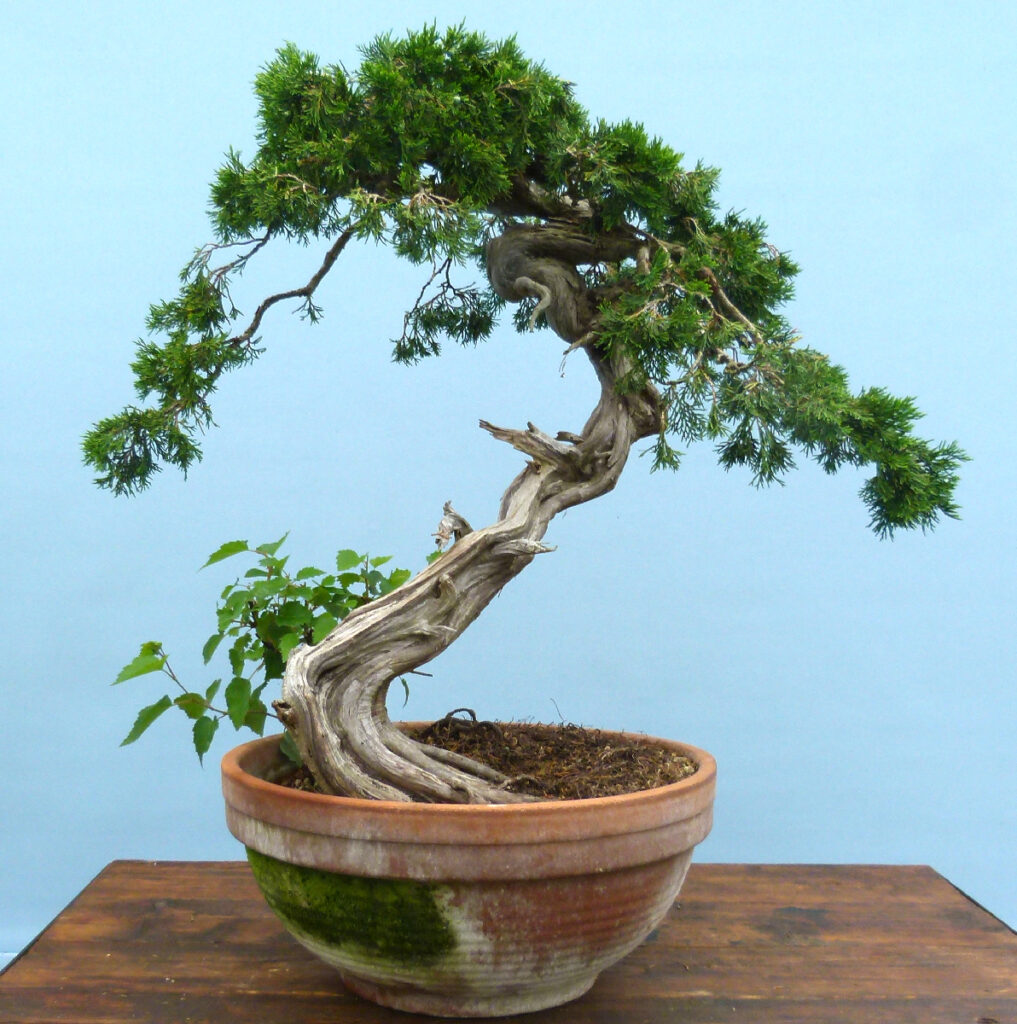
This sabina was never repotted correctly and has been wired way too early. I already removed the wire and a huge amount of dead material, now for the root work.
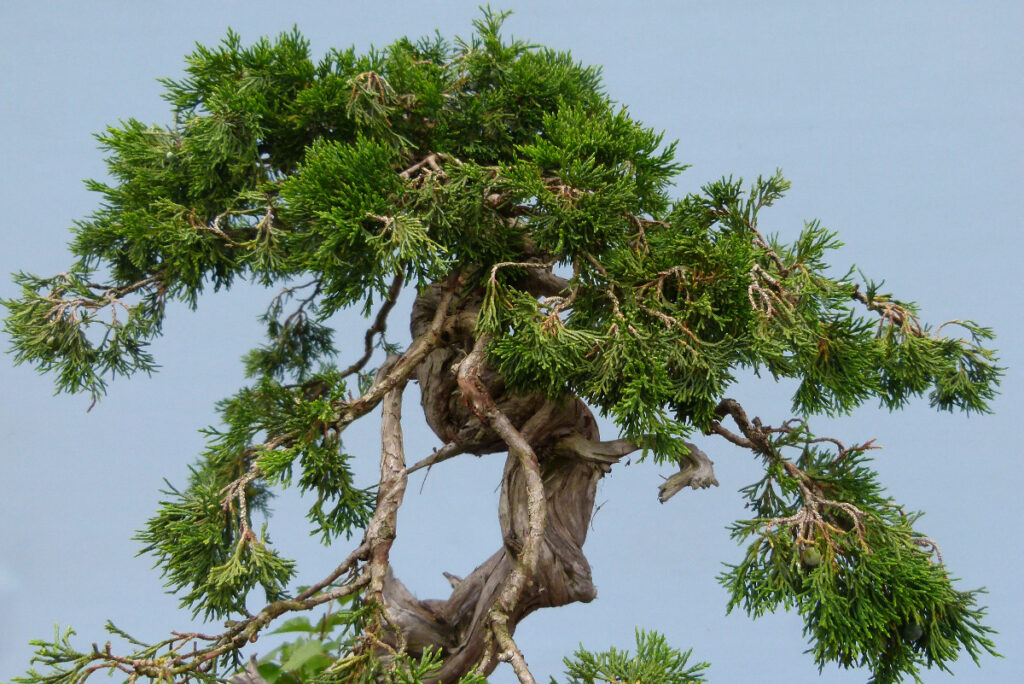
Here we can see some recovering growth and still a lot of weak floppy stuff and weak branches. Clearly there’s a way to go.
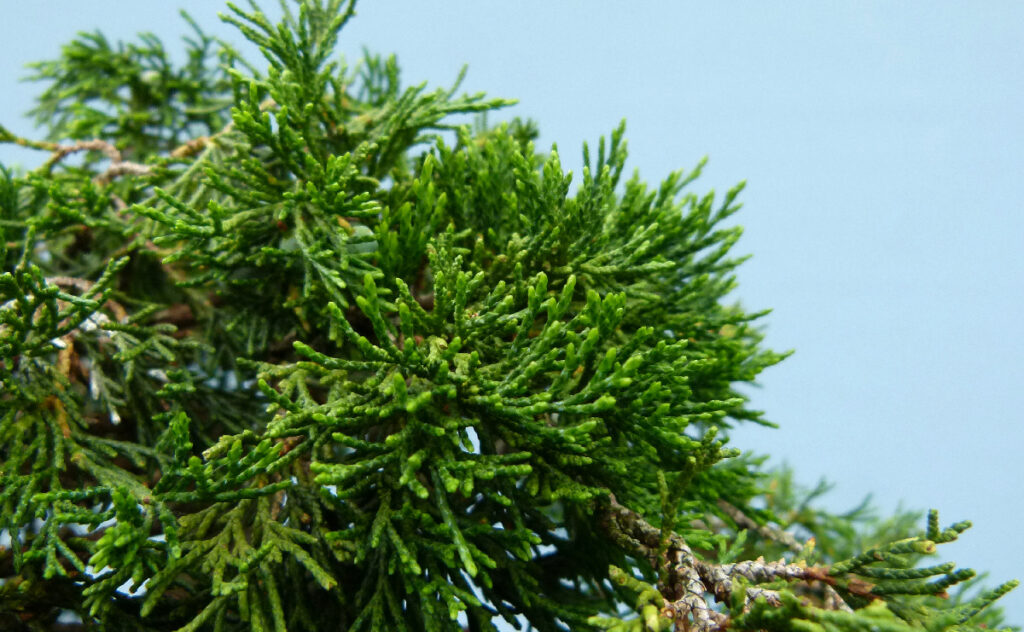
Here we can see strong foliage though it’s still not ‘running’ so more time required.
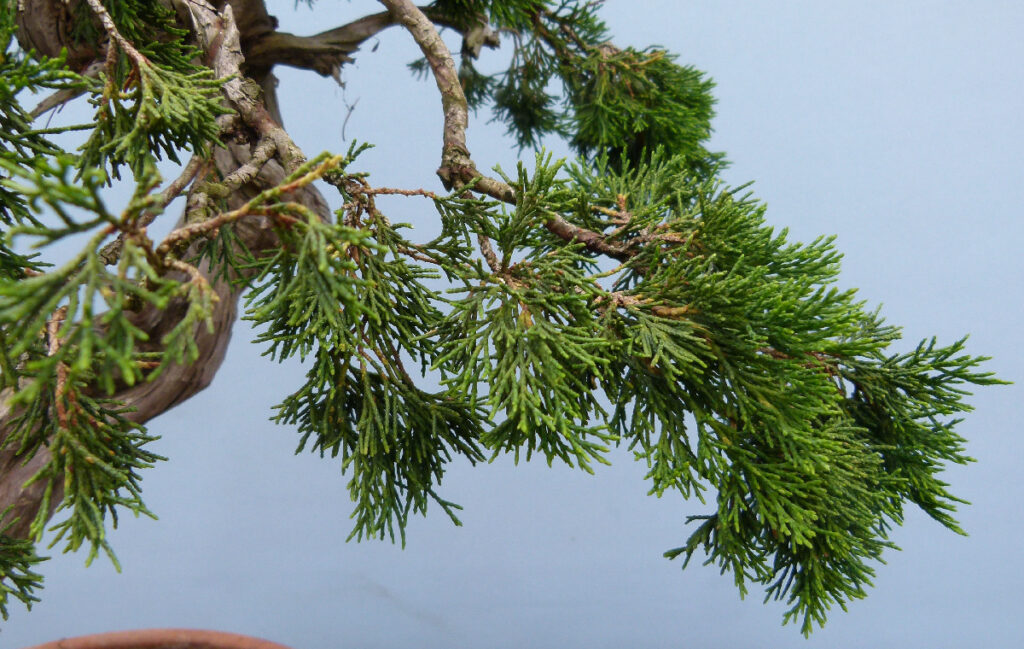
This branch is typical of overworked sabina. Long, floppy and pretty weak. Wiring this will NOT help in any meaningful way.
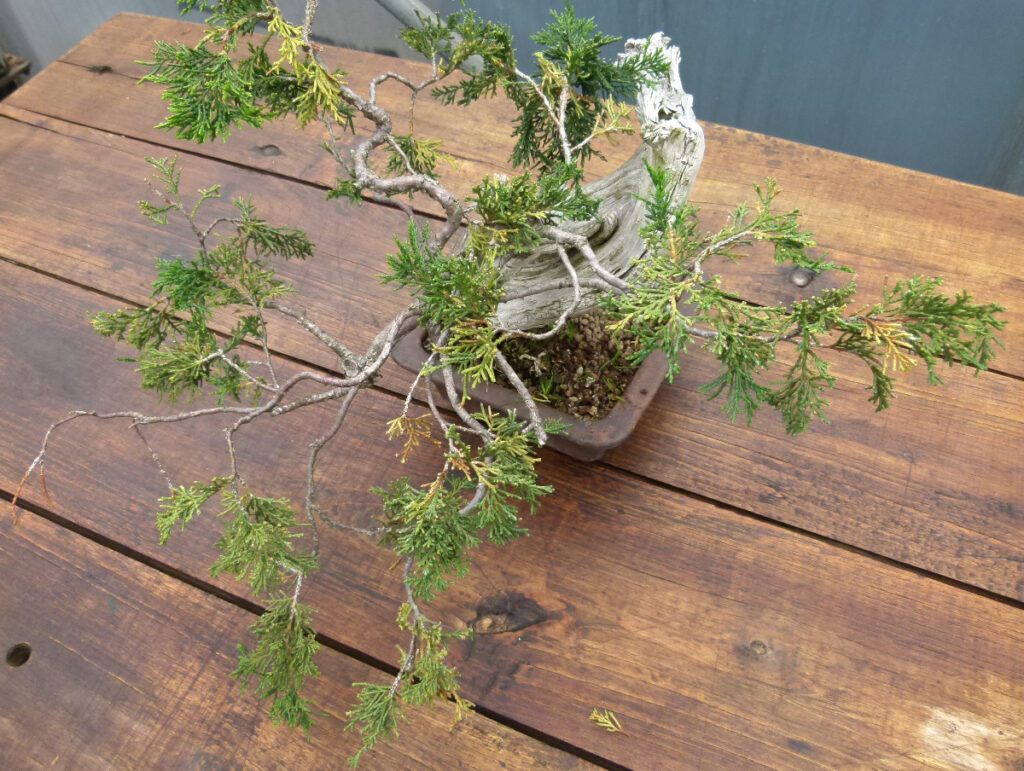
This cute little shonin size sabina juniper has been prematurely worked and has taken 3 years to recover to this extent. Clearly this is NOT the way to go.
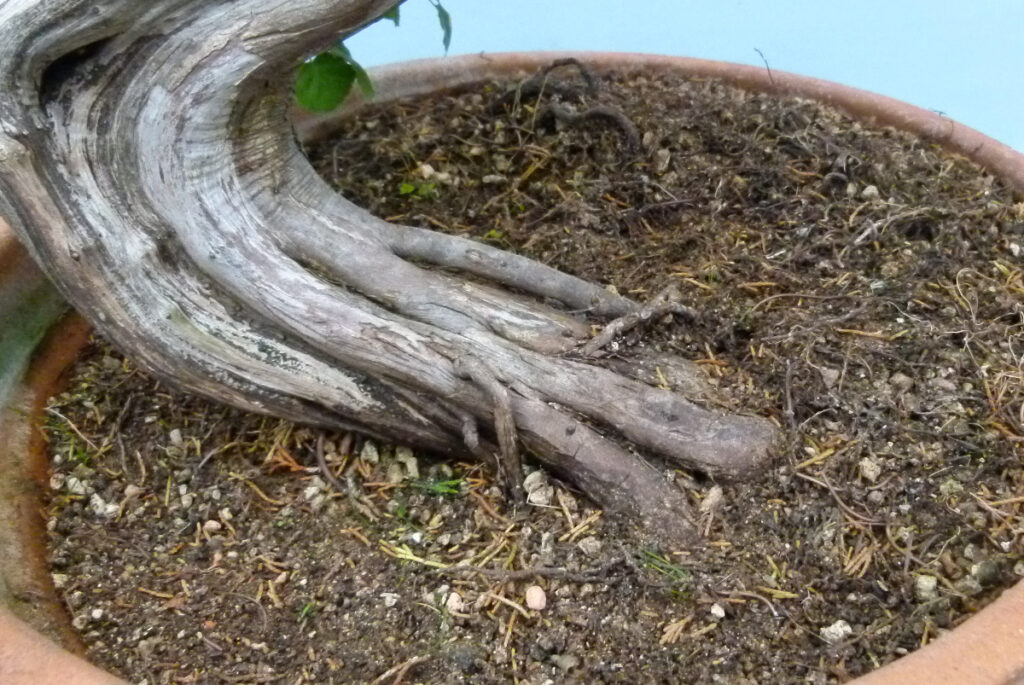
This juniper has been about 6 years in this pot but was never prepared properly and has consequently been very slow to grow.
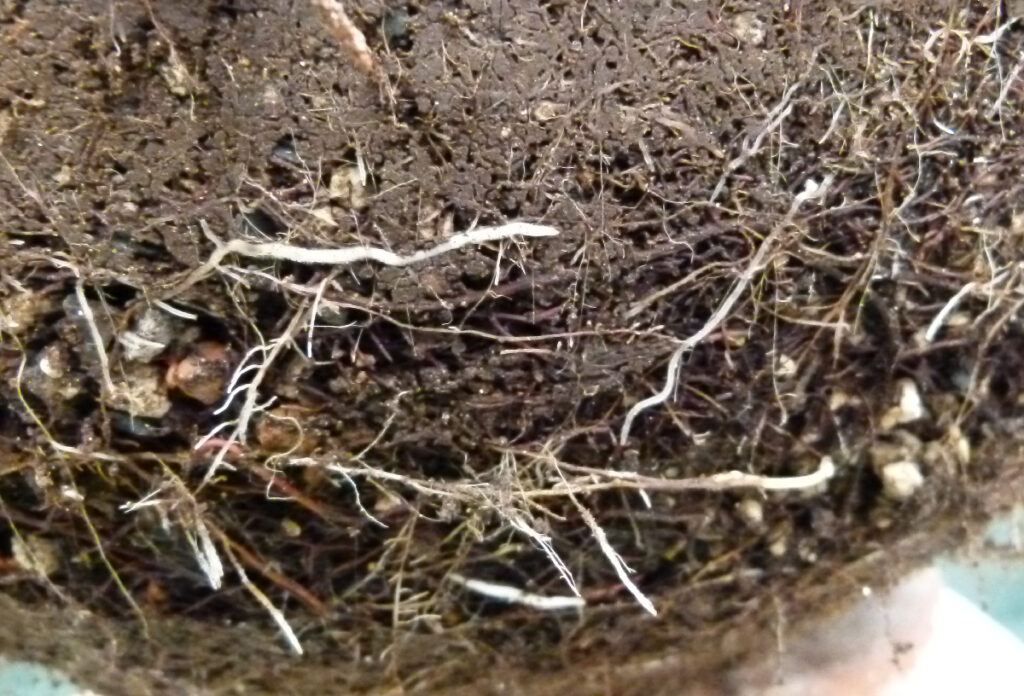
Fresh white root tips indicate root development has begun and so now is a good time to repot. (Uk. Mid-July)
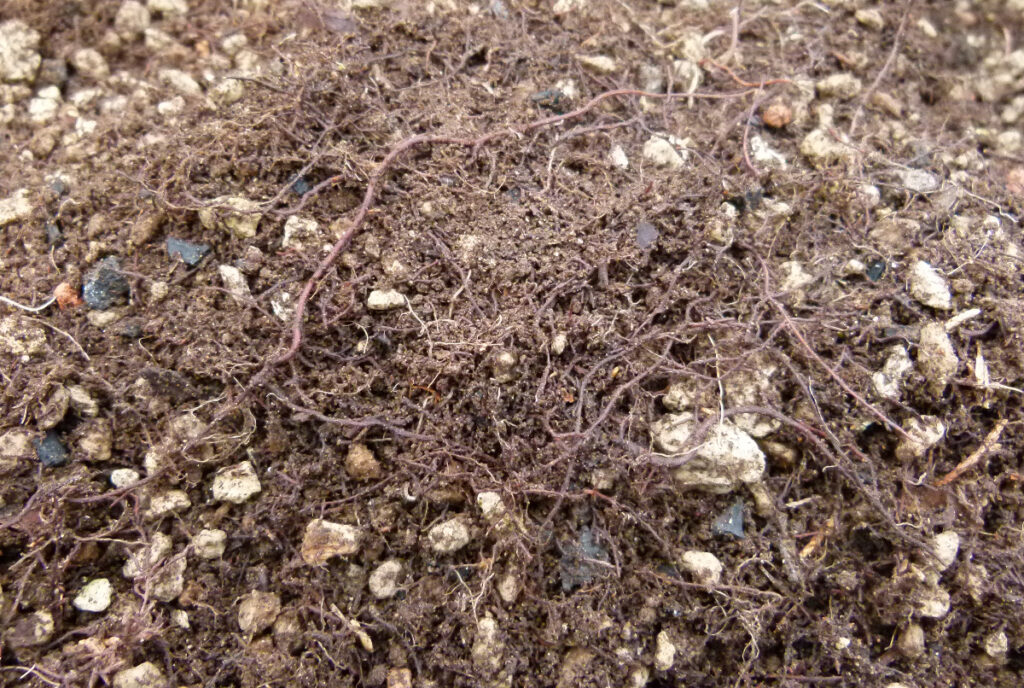
After cleaning out it’s clear there was a lot of crap in the rootball. The original mountain clay does not support much root development in a pot.
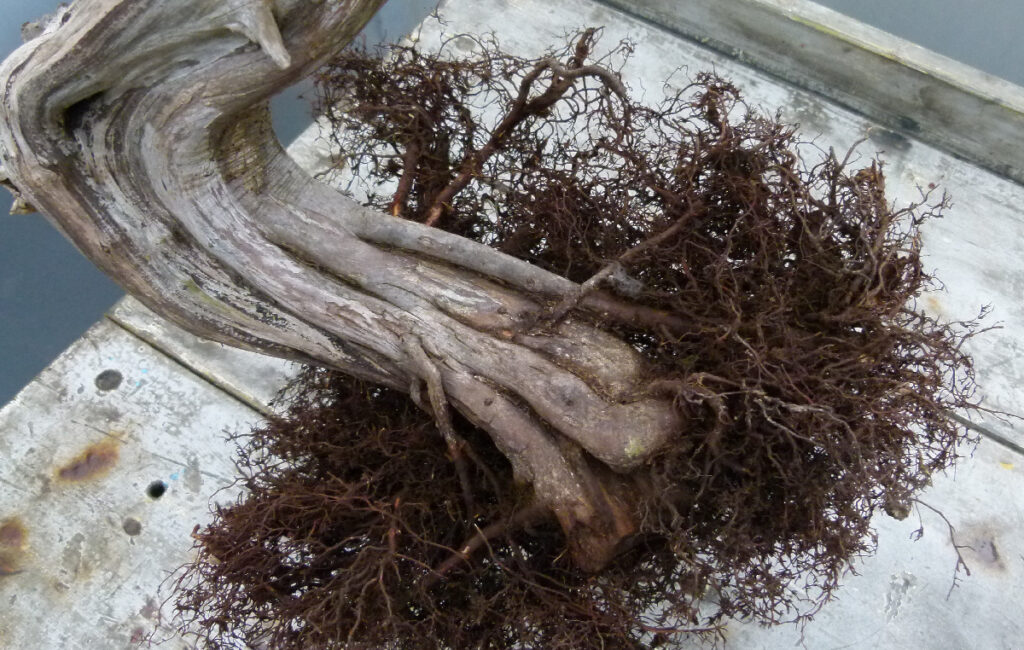
After gently cleaning we have nothing left except sabina juniper. Don’t wash!
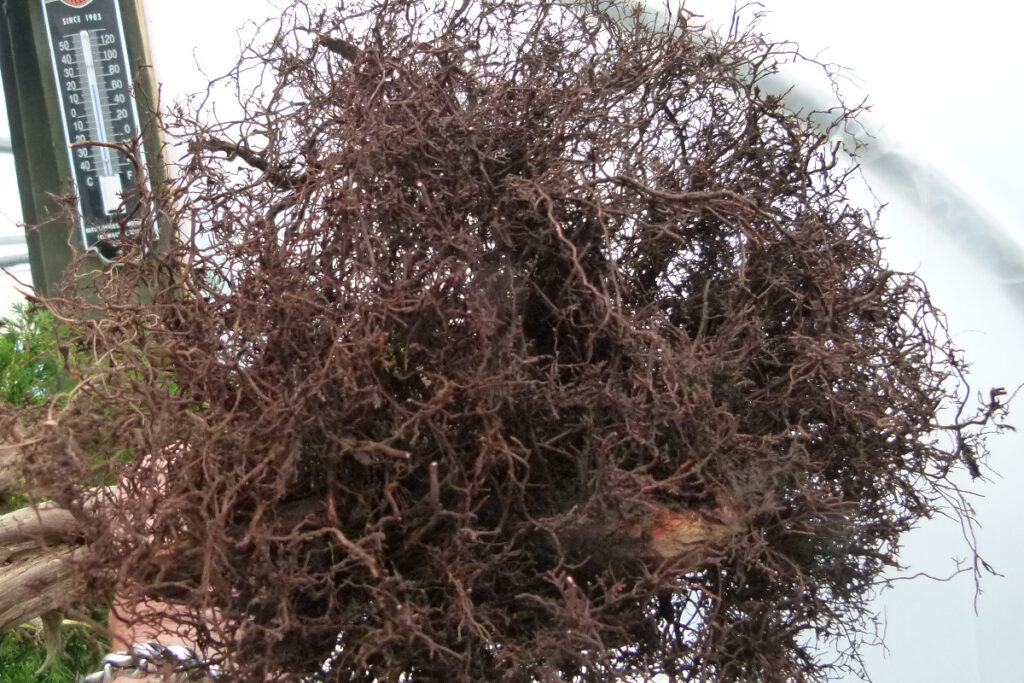
With the root system cleaned and pruned it’s time to go back into a pot.
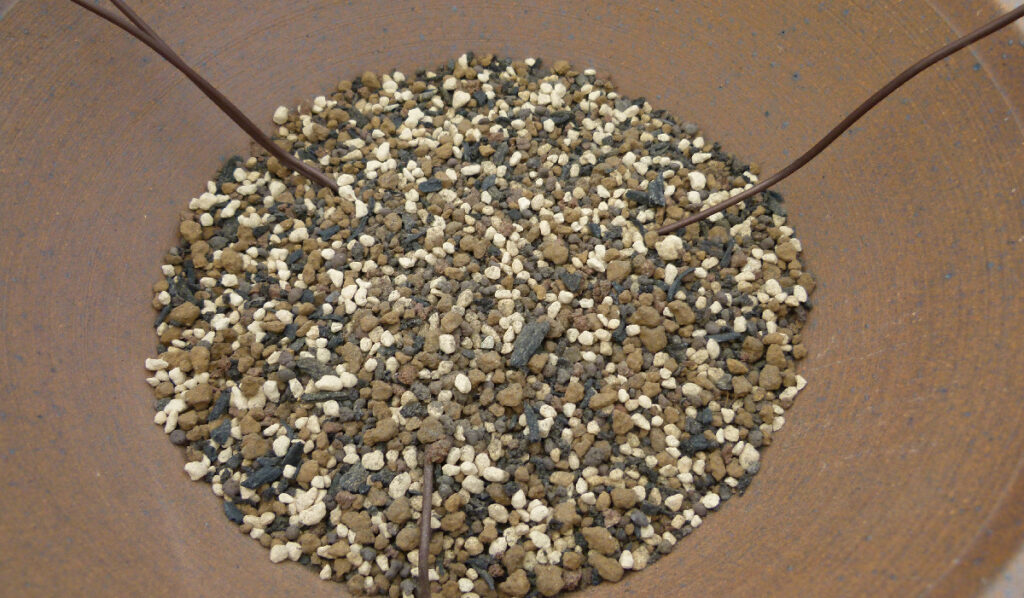
This mix represents a good starting point for sabina in bonsai pots.
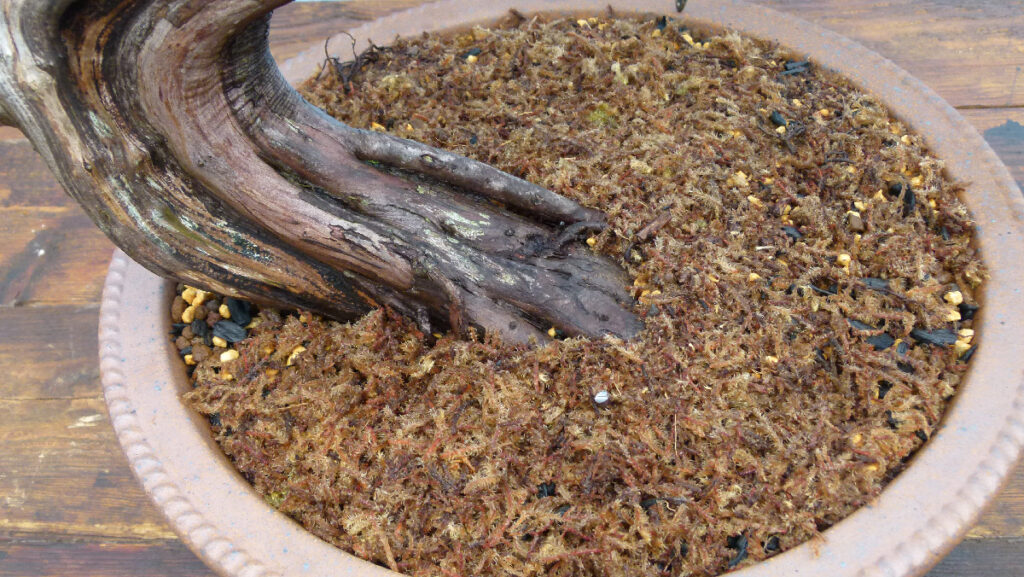
Chopped moss surface dressing helps retain moisture in the open soil surface.
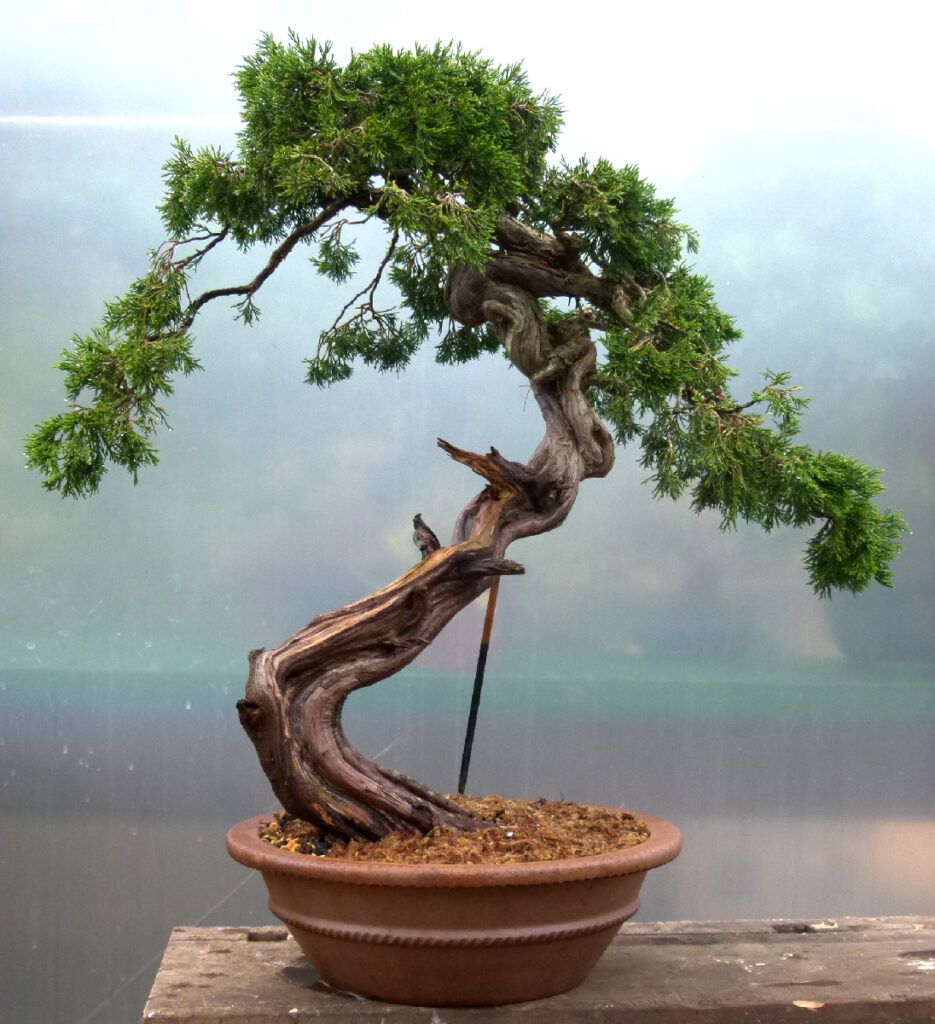
Work complete. The small pot is possible because all the space within it is available for new root development. Chopped moss on the soil surface prevents premature drying out in warm weather.
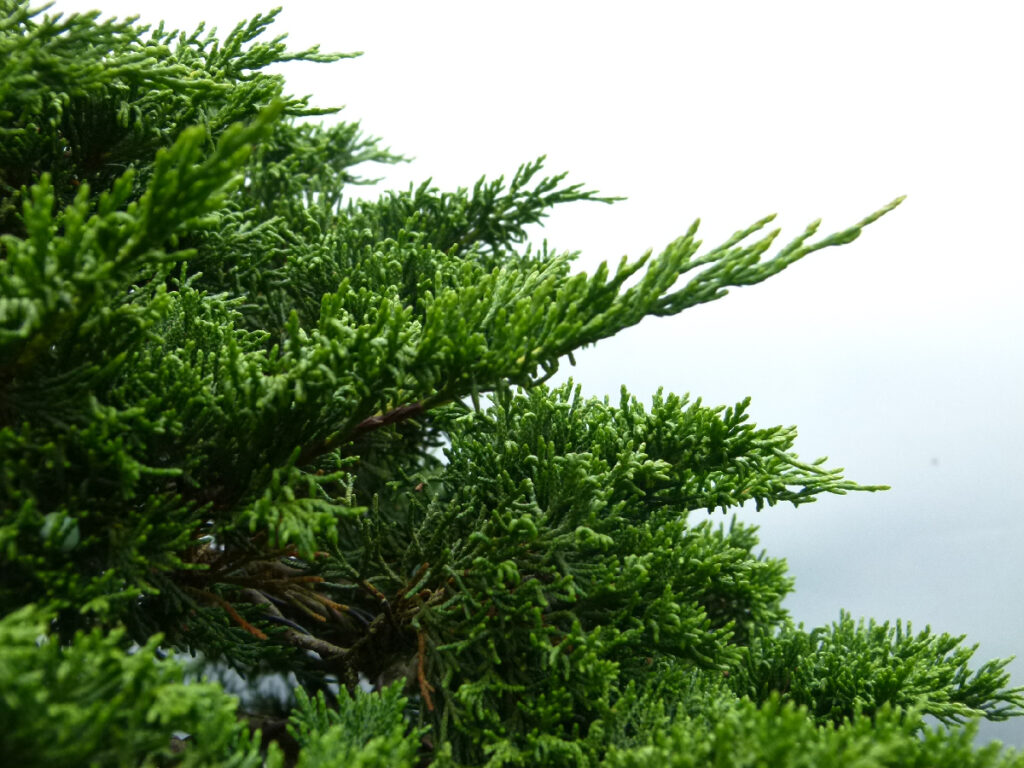
A different example showing running shoots. These are pushing from every branch on the tree.
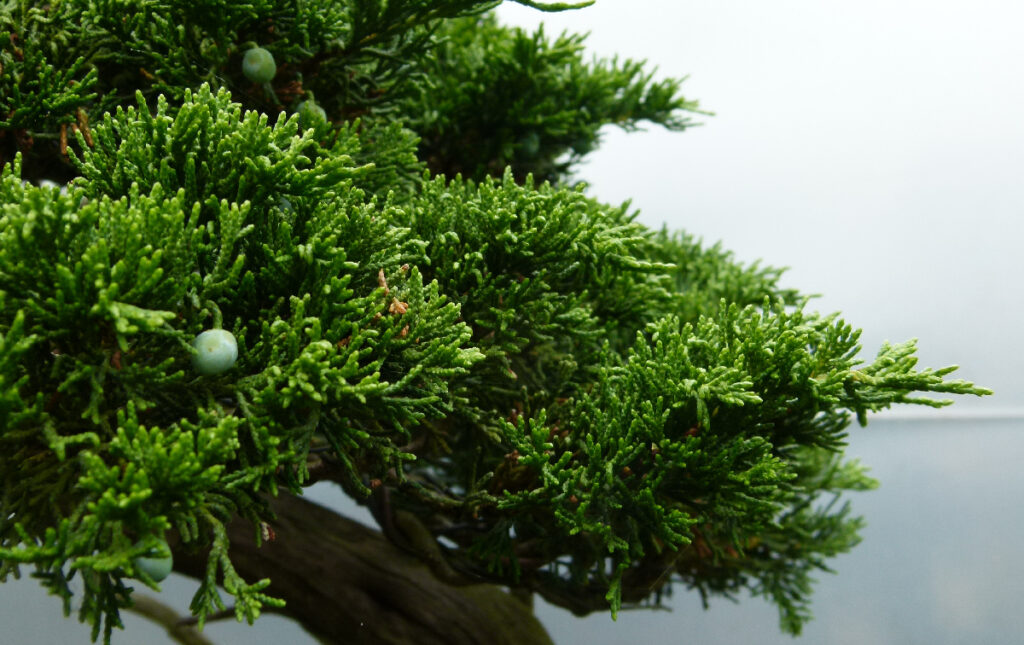
Strong growth just beginning to ‘run’. Just leave it alone!
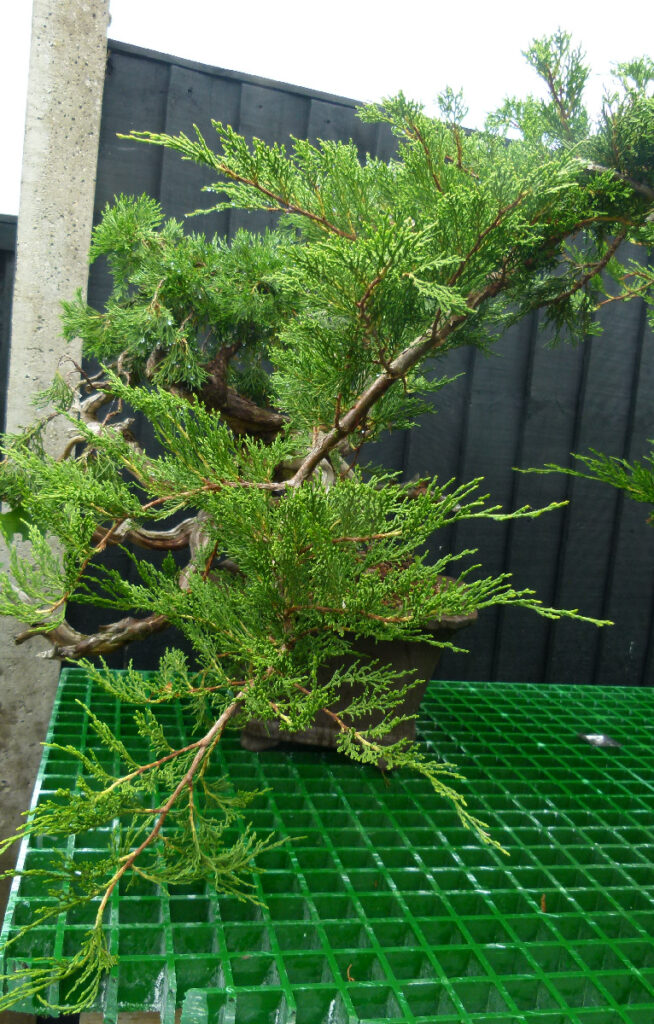
Another tree. This running shoot is nearly a meter long and grew, in a bonsai pot following a correct repot, in just a single season.
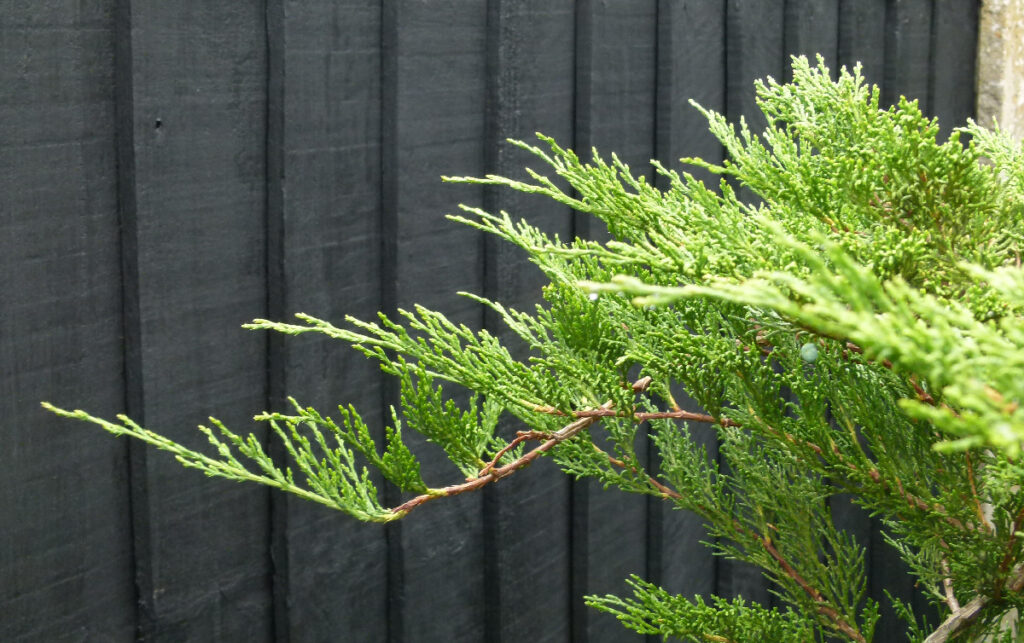
Here we can see what strong running shoots look like. Strong, vigorous and self supporting. This is what we want to be working with. If a juniper does not look like this it’s not ready.
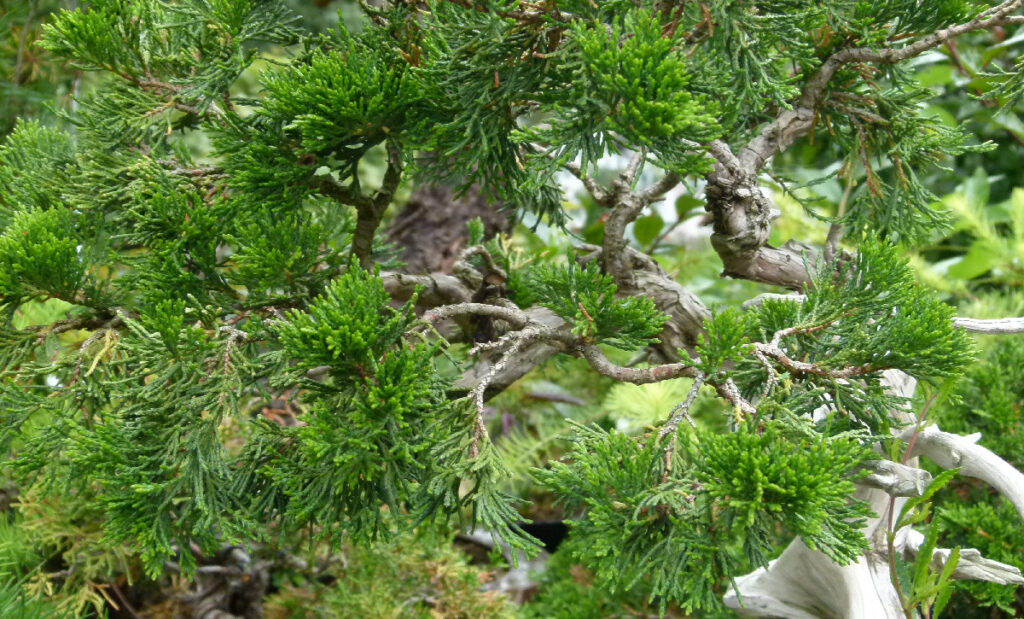
Here we can see back budding from the forks of branches. These are the future of the bonsai and in time can be used to replace long, weak or leggy material.


Great article Graham, I’ve been growing bonsai for close to 40 years now, over the years I’ve killed a fair few. When we had that bad winter a few years ago (-12) I stupidly left my Trident maples out and then in the spring wasn’t surprised when they didn’t open out in leaf, 3 dead Tridents entirely my fault. On the whole my pines and junipers are very sturdy trees. However, Sabina…. well, at one point I had 4…. I now have none. I’ve never been able to keep them for more than a few seasons and I am sure it’s the winter wet that killed them. The Kishu and Itoigawa just fine.. Sabina… nope. In the spring time they start to turn a little blue.. then almost grey then that lovely green changes into a light green eventually turning yellow.. dead. So sadly I don’t have any, even though they had the very best trunks I’ve ever seen. Still learning even after all this time.
Daniel sounds like spidermite. Have seen a beautiful strong sabina killed by mites in less than a month. That winter wet is not an issue once the soil is changed too.
Hi Graham, ah yes spider mites. Makes perfect sense. Quick decline certainly. Not sure if I’ll ever own another Sabina but if I do now I’ll know what to look out for!
Thank you Mr.Graham!!
Fantastic long but wise ramble!!
Bless you!!
Jozef
Graham
This really is invaluable information for all Sabina owners and goes to show that patience and correct cultivation will rewards growers of this mountain species. I have purchased a number of Sabinas from you over the years- all still alive and some flourishing more than others! I will certainly be putting this guidance into practice
many thanks
Hugh
An excellent tutorial and life hack, no more to be said really 🤔
You must be Pyskick, Graham. I was just trawling your blogs for info on ‘Juniper’ ‘repot’ and ‘soil mix’ 😀
Would you recommend similar treatment for Itoigawa?
Rich, you’ve a lot more leeway with itoigawa, much easier to deal with if you can keep them strong.
I really enjoyed the article and I don’t even own a Sabina!
People soon get to learn where to go for proper advice and I always recommend Kaizen if anybody asks.
On a more personal note, during this record breaking heatwave we are often asked to check on the elderly and infirm as they are most at risk, so how are you Graham?
Take care my friend and never change.
Hey Nigel. I’m good though the world is seriously getting on my nerves and I’m fed up with watering just now. Could do with a hand weeding if you are free 😉
Graham I appreciate your rants, skipping some of the political ones , but this one is superb…
I now have a better understanding of my Sabinas thanks to your article…
Cheers
Dude…
BTW do you do club chats ?
Tony
Hi Tony. Yeah that politics does nobody any good. I do a few clubs but i don’t tend to go inside the M25 if i can help it. You could always bring the club here 🙂
Always interesting to read Graham.
I’ve killed so many trees over the years and that’s mostly been over-watering which embarrasingly, I’ve only recently discovered. Because soil mixes are free draining etc I thought I couldn’t over water and assumed it was improper fertilizing!? What an idiot!
For some reason my Sabina’s from you are ok, maybe it’s because I’ve left them alone except for maintenance thinning, wondering how to style them , same story with one of your old Mugo’s that I’ve got.
Interested in the repotting schedule every 4 years or so in late summer so I will check mine out this year , they’ve been untouched for probably 6 years now.
Thanks Graham for sharing your experiences with Junipers – if more so Sabinas this time round. Always interesting to read your blogs – and I do pick up some useful information 👍
Until early .ast August (2025) I didn’t have any Junipers… having seen and read of so many being killed off in one way or another. Last August, attending a bonsai ‘boot’ sale in my locality (this year it’s a bit earlier being on the 26th July), to try to sell on some starter stock, I was given a small Itiogowa – for helping another seller next to me. It’s still in the small pot, sitting in front of my Japanese maple forest group (from airlayers) and seems happy enough. I was thinking about a repot and, knowing you do some with yews and pines in the summer months, wondered if now is about the time to do it? I was going to look up your vids on YouTube…
Hope you keep well and don’t let the ‘blanks’ (insert a term of your choice 😉) drag you down – as I’ve got older I’ve given less time to such…
All the best going forward