As I said in my most recent blog post “Bonsai is not easy”. After 30 years I begin to think I don’t know s**t. There are just too many variables to contemplate and the British climate certainly does not help matters.
Almost every day I am asked for my help and advice about some aspect of cultivating bonsai. I have no issue with sharing my best know-how with anyone who asks. However because there are so many variables involved, what works like a charm for me could have the opposite effect for you.
Years ago I moved house. I only came three miles down the road and whilst the garden was about ten times the size of the previous one it might as well have been in a different country. It has taken me years to master our new spot which seems odd when I am all but in sight of the old place.
Add to that the fact that two identical plants, even from the same source will grow differently from each other. Then two different people will be wanting to achieve different things with either of them and it becomes obvious the variables are all but infinite. That alone makes figuring out bonsai something of a job.
My best advice is to learn the principles of horticulture and the process of bonsai by painful experience. Given enough years it becomes possible, most of the time, to figure out what needs to be done to achieve our ends.
Every now and again I have been thrilled to see a plan come together. Sometimes the problems stop for a while and just like parting clouds, success shines through. I generally have to stand back and just marvel and enjoy the moment. One such experience came about this summer and the bulk of it was not by design.
Over the years I have developed a love of Mediterranean species we use in bonsai. Most of these have been a real struggle to understand in our oppressive British climate. However over the decades I have learned how to make them all work here. My favourite is the cork bark oak (quercus suber) and that would be quickly followed by Pistacia.
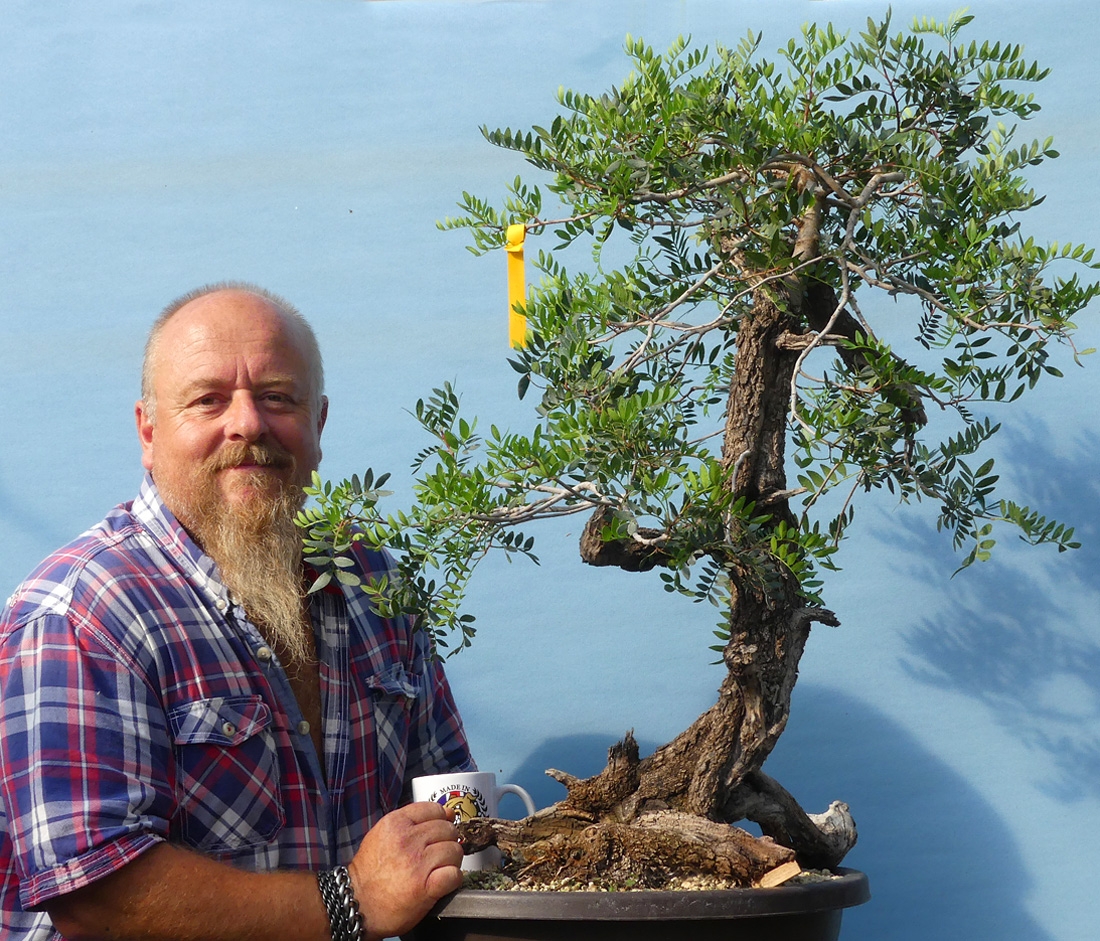
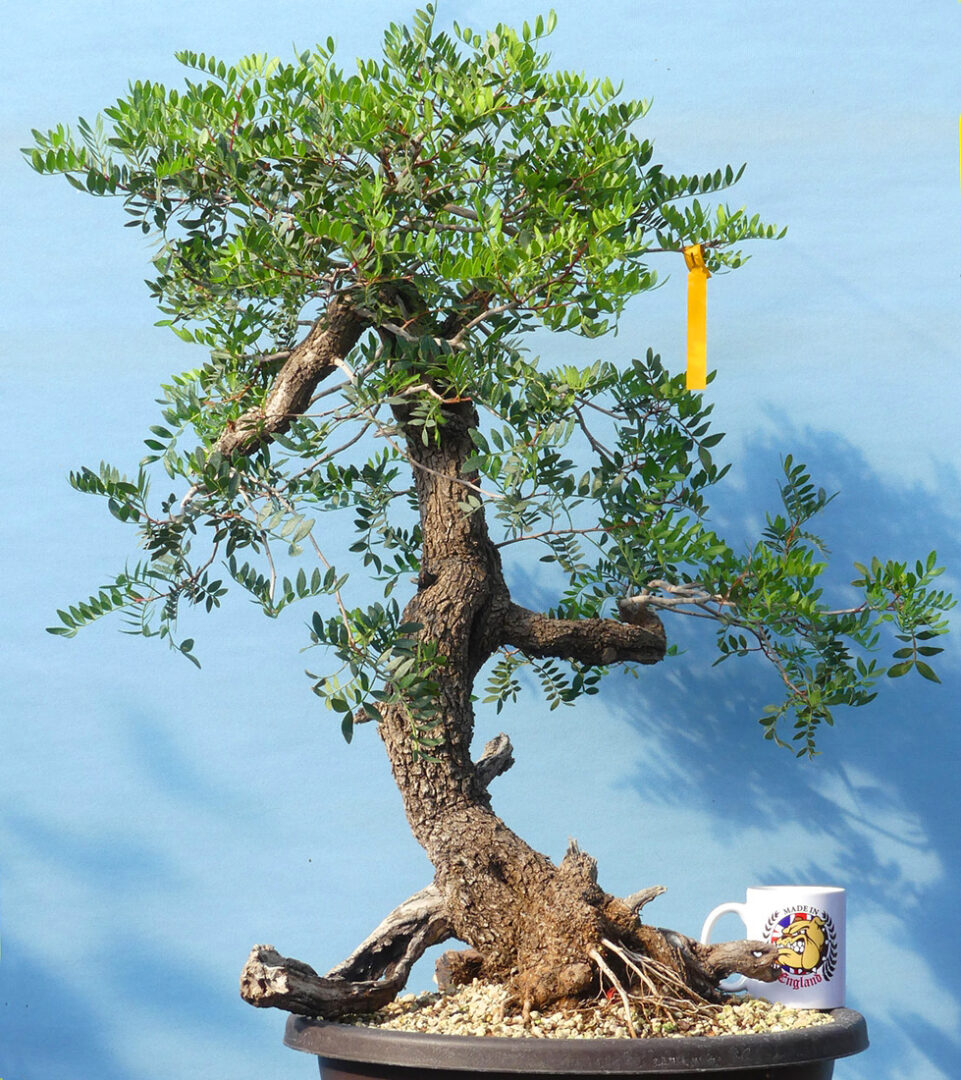
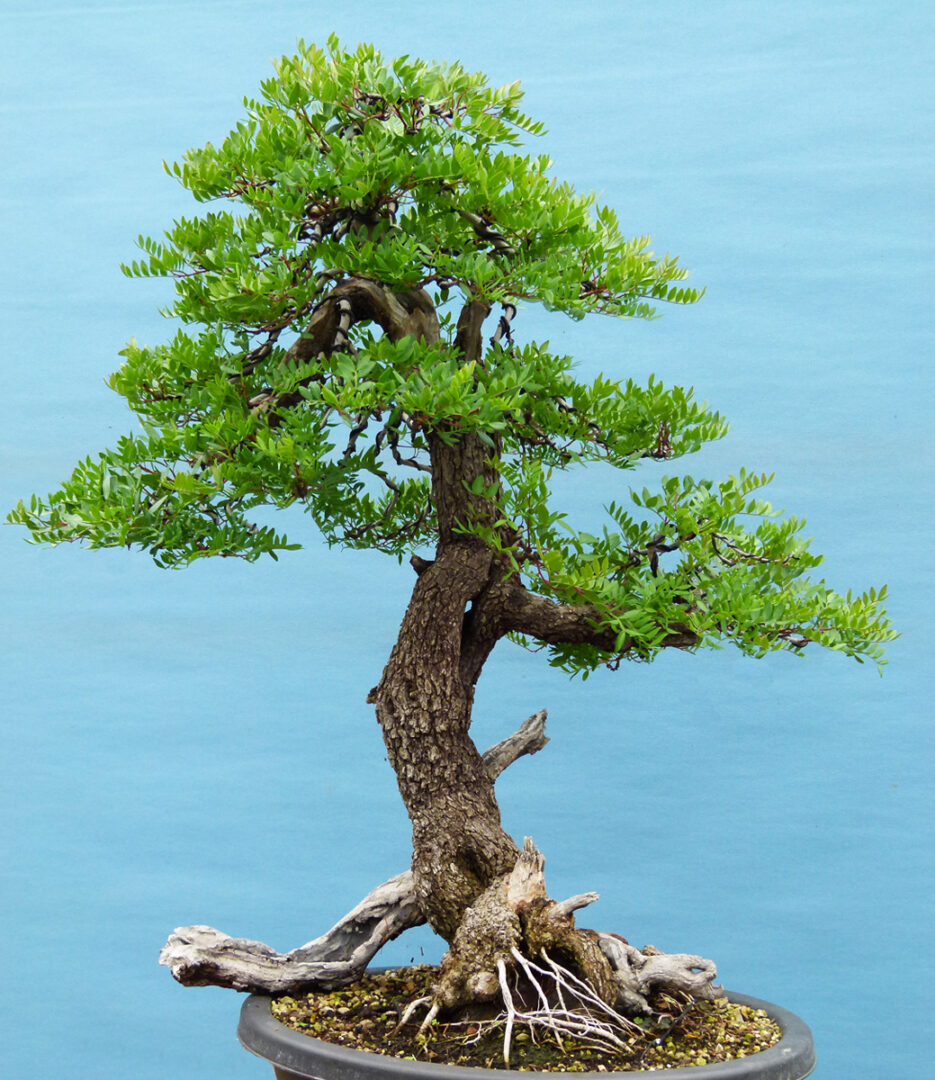
Pistacia yamadori from southern Italy. Spring 2020. Several years of preparation have passed.
Big leaves from last summer.
My job dictates all my best trees always get sold, which sucks. I have to content myself with enjoying the process rather than the end result. It’s scant compensation but I put myself in this position. Over the years I have had some spectacular pistacia and have rarely had one long enough to see them develop.
I bought this particular tree from a collector in southern Italy a couple of years ago now and, strangely, nobody considered it worth buying. In that case I jump on the chance to develop a tree as far as possible before it leaves me. This one got bare rooted and potted into a plastic tub at the height of summer 2019.
2020 has been the busiest year of my life and so time to work on bonsai has been largely non-existent. However one evening around June time I pulled this tree out to rid the pot of some weeds. A couple of hours later and I had it defoliated and wired. It’s had a good summer.
Here is what I have learned…
As with most, but not all, Mediterranean species, re-potting should be done only when the trees are in active growth in summer. Re-potting too often severely weakens most varieties.
Most larger leaf evergreen Mediterranean species need to be defoliated at last once a year, in some cases twice. This encourages strong growth but, pruning new growth too often or too early severely weakens most varieties.
Most Mediterranean species respond best to wiring, styling and pruning only in summer.
Most Mediterranean varieties need a lot of direct sun. High temperatures are less important than direct sunlight exposure.
Allowing a tree time to develop before styling always pays off. The longer the wait the greater the benefit. Mediterranean species we use in bonsai are something of a fish out of water in the UK. Give them time.
Back when I started this journey I found bonsai to be a great relief from all the ugliness in the world. Thirty years on and the ugliness has increased exponentially. However some trees just want to be beautiful and this is one of them. I know it’s a long way from really being a bonsai tree but after all these years I am learning to enjoy what’s in front of me rather than fussing about what’s come before or what’s coming next. Enjoy the good moments, they are far too few and far between.
Minimal interference allows a tree to express it’s true beauty.
Growing, creating and keeping bonsai trees is REALLY hard. After more than 30 years I should know. Over the course of those busy years I have seen a few things, done a lot of other things, had countless failures and even the occasional success. There is just SO much we need to know. It’s not that growing trees is hard. They grow everywhere we leave alone and thrive in every nook and cranny of the planet where water and light are available. Why then is it so hard to keep a little example in a pot? Assuming we have soil, water, air and light what’s the problem?
Well, of course it’s US. Think about everything we know that’s f’d up in our world today and with a little study and careful thought you will discover we are the underlying cause of pretty much all our own problems. NEVER underestimate the ability of human nature to overcomplicate simple things. Assuming you have a garden go mark off a square meter of soil, put a string around it and then just leave it alone, entirely. I will guarantee that within a year you will be able to find some sort of tree beginning to colonise the space. If it’s so easy to get a new tree in your garden what’s so hard about keeping bonsai?
At it’s root (excuse the pun) our problems stem from the fact we simply do not know what we do not know. There is no shame in that, we all start off knowing nothing and over time we learn. It’s what we do and it’s called compound learning. Most people know about compound interest and why you should save money early in life. The interest on interest causes the invested amount to grow exponentially over time. A similar process also governs your life learning and bonsai potential?
Learning works just like compound interest. The more you try to do and learn, the more you understand how things work and how to learn better. These insights and experiences combine to create compound learning. A long way down the road a little fact can have a profound effect on what we know because we have amassed so much knowledge. However in the early stages the little details have a less pronounced effect because there is less context and interaction between salient facts. That’s obvious when stated but rarely considered when we embark on learning a new discipline. Initial progress is going to be slow.
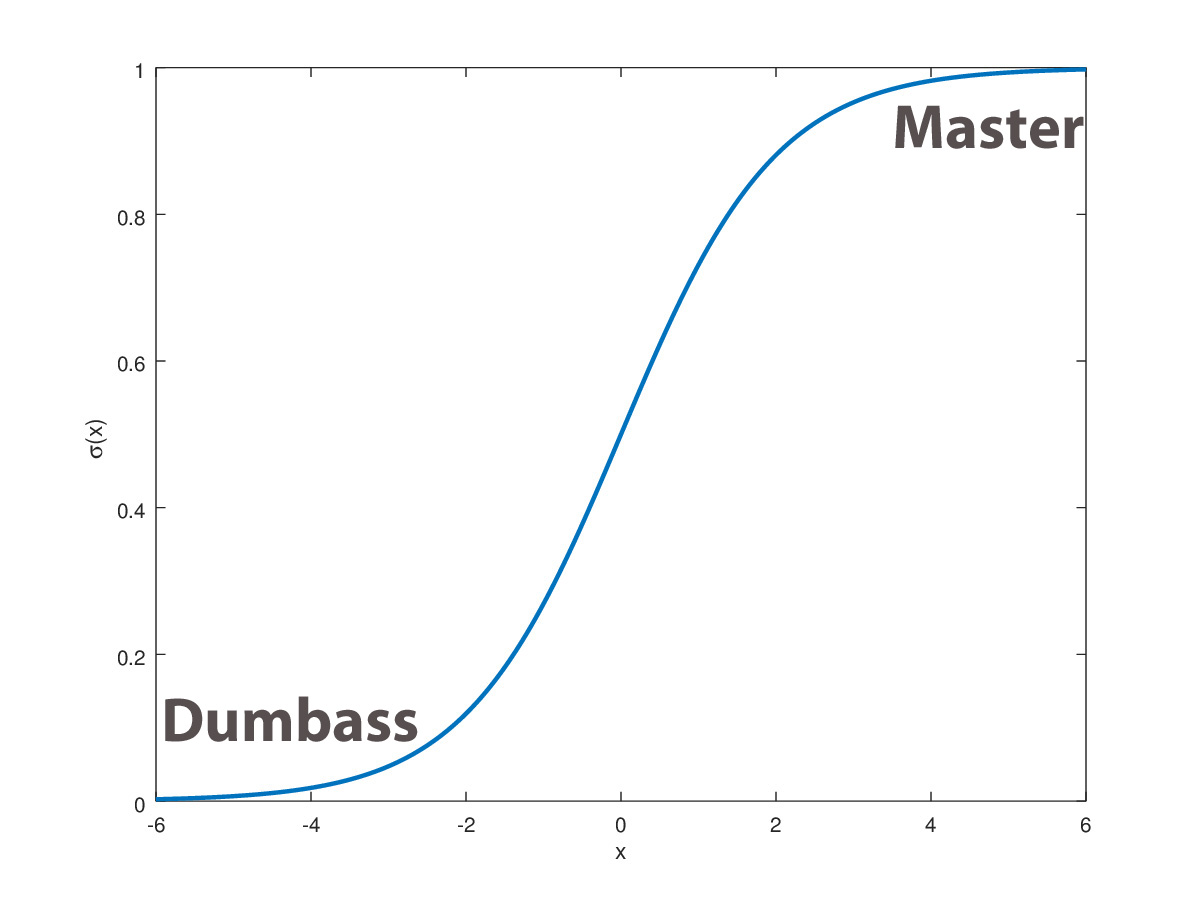
For success-based activities, there’s a standard learning curve called the Sigmoid curve (or S-curve). It grows exponentially just like compound interest but it starts off slow and has a plateau of mastery at the top. Put simply it’s like a heavy truck that is slow to pull away but once the momentum starts to build progress is strong unless we try to go too fast then the rate of acceleration will again begin to slow before reaching a terminal velocity. It’s at this point most folk will plateau because further learning is really hard. To keep moving forward is hard and the steps are very small. It tends to feel like we are just treading water. I might say that the juice is just not worth the squeeze, or so it seems.
The Sigmoid curve
The Sigmoid curve shows that going from nothing to capable could take as much effort as going from capable to absolute mastery. Things vary from the standardised curve, but it’s a rule of thumb that can inspire determination. Malcolm Gladwell, in his book Outliers: The Story of Success, repeatedly mentions the “10,000-Hour Rule“, claiming that the key to achieving world-class expertise in any skill, is, to a large extent, a matter of practicing the correct way, for a total of around 10,000 hours.
Back when I was a fresh faced youngster it was common practice to take a spotty sixteen year old school leaver and pair them with a grizzly old bloke in the workplace. It was called an apprenticeship. It gave a boy the chance to not only learn a trade but to become a man and be a productive and respectful member of society. It also gave an old fella a fulfilling chance to pass on his experience and, often the opportunity for a good laugh at the lad’s expense. Stories of ‘elbow grease’ and ‘striped paint’ are legendary. In the printing trade one lesson involved the discovery that red ink gave off heat. A fact you would discover was not true whilst struggling to get it off your thoroughly covered and soon to be bright pink hands.
An apprenticeship was typically five or six years by which time a young fellow would be considered competent and as a journeyman would be allowed to work as a qualified person. However it would be a long time before a journeyman would become a fully elevated master craftsman, if ever. To become a master, a journeyman has to submit a master piece of work to a guild for evaluation. Only after successful evaluation can a journeyman be admitted to the guild as a master.
All told, learning to be very good at something was, and is, going to be a long road. Sadly however, in many instances today we have become lazy and just want a short cut. In our digital age, apparently, everything is simple, easy to achieve and guaranteed gratification is instant. Remember that scene in the Sopranos where Christopher is hoping to become a screenwriter? It’s going badly and he can’t figure out why especially considering he bought a computer that he thought would do a lot of the work for him. Learning the simplest of things is going to be a life long journey assuming we want to be any good at all.
The one thing I have learned about learning and bonsai is that the more I learn the more I have to change. Just because something does not suit me does not mean it’s not true. Often I have to bend to incorporate some significant factor. I know a lot of people that have purchased expensive bonsai and then, mid-summer go on holiday without making appropriate arrangements for care of their bonsai. Often on their return their charges are dead. Many times I have been asked to “do” something. Trust me, if I could raise the dead I would no be doing this! Solution? Don’t go on holiday, go away in winter or make suitable arrangements. To carry on as normal, having taken on the responsibility of a living thing, is simply stupid. If it were a child one would be locked up and publicly excoriated for such actions. Success demands change, unless of course you already have more than you can cope with.
Learning bonsai is like building a house, one brick at a time. Bonsai really has to be a way of life that will ultimately touch every area of your life and help you be a better more patient and considerate person. At least, in my head that’s how it works. Nothing in bonsai happens in isolation, it’s all connected. Every single day I am asked the question “What sort of soil do I need for XYZ species of tree”. For the inexperienced that’s a perfectly valid question but, in reality the answer could easily run to three hundred pages if your friendly bonsai master were to give you the answer in context. Ultimately it’s complicated but only if one is at the bottom of that Sigmoid curve. At the top it’s easy, knowledge is king.
Back in the day when I knew everything about everything, everything was pretty much simple and obvious to me. I was what is colloquially known as a dickhead. In my later twenties I woke up and realised I had to get busy. Thankfully I learned two powerful guiding principles for success.
1. In order to be successful do what successful people do.
2. Spend time with people who are where you want to be.
A good example of how that worked occurred in my late teenage years. Back then it was a big deal to go fast. Most cars were laughably slow and few road-going motorcycles were genuinely quick. I had the biggest bike I could afford (we didn’t borrow money with the aplomb folk do today) but my car was given to me for free. I loved Mini’s back then and I was consumed with making one go fast. With no internet it was down to magazines, books and word of mouth if I were ever going to figure out how to achieve such a feat.
Eventually I came across, and kept hearing just one name. David (The Wizard) Vizard. The man’s work on the Mini engine and it’s performance is legendary in those circles. As far as I could tell nobody had really taken that little engine quite as far as he had. Not being a mate of mine all I could do was buy his massive book Tuning BL’s A-Series Engine. This became the pillow on my bed. Finally after close to a year of intense study I began to understand the principles of performance. Long story short, one of my Mini’s ended up with over a hundred horsepower at the wheels on a rolling road. That’s over double what it started with and made a genuinely fast (if terrifying) little car that could easily beat all the stock turbo offerings of the day in a traffic light drag race.
I achieved my goal because I dedicated a year of my life to understanding what Mr V was teaching and then did what he did and low and behold I got exactly what he got. Could it really be any simpler?
Today everyone’s first port of call with a question to answer is Google. They are pretty good at matching things up. However it is down to you to decide if what they serve up is relevant, helpful or even correct. In my own research about virtually anything a Google search seems to lead me to a similar question, often asked on a forum or social media group. These are open to comments by anyone and often go like this…..
I was recently searching for information about an obscure American made item called a Reece Fish Carburettor. The first hit on Google was a forum about old cars where someone was doing exactly what I was.
Here is the first response…. Wow, haven’t heard that name for a few years. I haven’t got any first-hand experience with them but……..No first-hand experience? Better shut up then because you are not going to help me out with your unfounded opinions.
Go online and search a health related question and see what happens. I had a bad case of kick-starter foot. Like an idiot I had been kicking a super tight rebuilt Harley Davidson engine and without really concentrating had been using the ball of my foot. The result was badly damaged tendons between the front and back half of my size 10. It was hard to walk and ultimately took a year to heal. The result of a Google search was at best….. your an idiot, your foot if fucked, cut it off and die…. A painful little swelling on your head will inevitably be cancer eating it’s way out of you. Nobody would even consider it might just be a zit.
Try the same with bonsai and you will very quickly descend into a morass of incalculable and insurmountable misery. As an example a friend of mine had a little mushroom appear in the pot of an old yamadori larch one autumn. Asking online he was advised the tree was infected an should be burned as soon as practically possible. Ten years later the tree is in robust good health as is the fungi that produces it’s little mushrooms every year. In the words of Edgar Allan Poe “Believe nothing you hear, and only one half that you see” and don’t burn bonsai trees.
It’s easy to be impressed as a fresh faced newbie and even easier to get your head turned by a good looking something. As I mentioned earlier, being a master of something is entirely judged by those that have gone before. The status of “Master” can only be bestowed by other masters. Self proclaimed masters are no such thing. Self confidence, bullshit and bluster are no substitution for a life of learning. Pick your Sensei carefully and guard your mind jealously. Picking up every bit of trash that crosses you path will leave you up to your neck in worthless trash.
I am often asked how one should go about learning the art of bonsai. My answer will always be the same five step plan.
1. Get a copy of Bonsai Basics by Colin Lewis. The best book on the subject in the English language.
2. Get a copy of Principles of Horticulture by Charles Adams
3. Put together a full set of Bonsai Today magazines. Read and study the work of Japanese bonsai masters every single day until you drop dead.
4. Buy lots of cheap plants (not bonsai) and learn to keep them alive. Bonsai horticulture takes 10,000 hours to understand the basics. Having accomplished that you will be ready to start thinking about bonsai trees.
5. Having completed the above your Sensei will appear to you. Learn all that you can by doing what they do and then some.
Add 50 years of tireless practice and just maybe somebody will call YOU a master and bonsai will seem easy but remember….
“The keenest sorrow is to recognise ourselves as the sole cause of all our adversities.”
We all like a little grumble. British are particularly renowned for our grumbling prowess. Mention the weather and see where that goes. The cost of a good bonsai soil mix?
We all like to grumble about the price of things too. ” I remember when …..” that sort of thing. I have a lovely old mate who pointed out a fairly average bonsai tree for sale on our bench cost more than his first house. On investigation that was about 65 years prior to our discussion. It’s all relative though. My dad likes to point out his first house cost him what is now the price of a special pair of handmade shoes but then he was earning 2/6 a week.
Money is not worth what it was and there is nothing we can do about that. However as age advances it does become difficult to deal with. I was discussing the minimum wage with my old fella the other day and he nearly passed out at the cost.
As a seller of products we constantly have to wrestle with making enough profit to keep the wheels on whilst not pricing ourselves out of the market. It’s a tough one and we (at KB) will not be able to retire on the proceeds. We all know about the crisis in high street retail and online retail is absolutely no better. They say the costs are less for online sellers but that’s utter bull crap.
There is rarely a day goes by that I don’t get bitch slapped by someone complaining about the cost of stuff. It goes with the territory but that does not mean it does not hurt. It really digs deep and the lack of respect and understanding is deeply offensive.
The real problem is that everything looks quite simple from the outside. Creating a bonsai tree looks like a simple thing to the uninitiated. We know better of course. There is nothing more enlightening than to walk a mile in another man’s shoes.
I get a lot of complaints about the price of what we commonly call soil. Bonsai growing media, or soil, is a complex business as I outlined here Choosing Soil For Bonsai Trees. The time, effort and work, not to mention transportation, warehousing, mixing and packaging that goes into these products is simply beyond the comprehension of most folk who are not directly involved.
Processed clay aggregates of many different kinds are a large part of most bonsai growing media. Take a look at this incredible video. Consider the cost of build, running, maintaining and feeding this absolute monster. 90% of a good bonsai soil mix will have come from similar plants around the world.
Those products have to be bought to one place and then processed, blended, packaged and finally packed for shipping direct to your door. How convenient is that? I reckon the price of these things is incredibly low. Many products are cheaper than 20 years ago and don’t forget 1/5 of the cost goes onto the Westminster gravy train.
I am very grateful to companies like the one shown in this video. Their hard work, dedication and long term investment makes our silly penchant for little trees possible. Next time you pick up a bag of soil product remember this video.
When you make that first fateful move and obtain a ‘Bonsai tree’ you take the first step on a journey that just might last the rest of your life. It matters little that your first plant is most likely not bonsai at all. Mine was a sycamore seedling I lifted out of leaf litter in the woods on a dog walk and planted in a plastic plant pot. It could be a cheap poor quality ‘bonsai’ you buy in a garden centre, something you are given as a gift or inherit. The quality is perceived and matters little in our ignorant state of the time. To be clear I did not know what a bonsai tree even was (it’s a partly redundant phrase anyway) and had never even heard the phrase. I had never seen a bonsai tree in any form but I always loved trees and figured it would be nice to own a little one.
Some time later I bought a house that came with a ‘Koi pond’, another redundant phrase seeing as koi pretty much live in any pond. Having been an avid fish keeper since winning a goldfish for tossing a ping-pong ball into a bowl at the traveling fare back in the early seventies my new pond was welcome. You don’t spend much time around koi keeping before running into bonsai trees. Most are normally accompanied by shockingly naff attempts at Japanese gardening. Chinese pagodas, concrete Buddahs, deer scarers and so much tawdry, kitsch and tragic gimcrack it’s hard to know wether one should shit or go blind.
So, from the point I knew what a ‘Bonsai Tree’ was it all started to get a bit pear shaped. Ask anybody what ‘bonsai’ means and you will be regaled with the trite platitude about trees in trays / pots etc’. The emphasis is almost entirely on the pot. Surely it’s the ‘tree’ bit we need to focus on? However for the few of us that managed to cut through all the crap and actually get our arms around this thing the word itself is irrelevant. It may have taken me thirty years of dedicated work but I now know I don’t have ‘bonsai trees’ in fact I just have TREES. Plain simple little trees that I keep in various pots (most of which are NOT shallow, or dishes or even ceramic). That thirty years was full and busy! The crazy things I have done have impacted upon everyone close to me for most of their lives, caused me to quit my job, sell everything I ever loved and put me in hospital with life itself hanging by a thread.
I don’t suggest for a minute that, in order to be good at bonsai, everyone must do the same. However this IS a long journey fraught with danger and perils. You would assume that in this ‘Information age’ learning to grow trees and keep them small would be easy. After all just look at the volume of content out there. I always had a passion for learning new things and today what could be simpler. I recently learned to TIG weld, sure I need to practice and work at it but after about an hour I knew what I needed to buy and once it arrived I knew how to set everything up and within minutes I was sticking bits of scrap metal together.
I previously taught myself how to operate a manual metal turning lathe. Another project required knowing how to work with Marmorino (lime plaster). I learned to spray two pack paint, build a sandblaster and repair our cooker. I mastered the arcane electrical systems of British motorcycles and found out how to apply/repair the patina on my pre war truck. There is not a week goes by that I don’t have to learn something new and these days it’s all at my finger tips. What you are staring at now has incredible potential for life enhancement. Of course a modicum of intelligence and common sense are required in order to use this powerful tool. Sadly for lots of people it just leaves them looking like a tool swinging in the breeze.
Just using the word ‘bonsai’ implies that our little trees are something special, something apart or removed from their wild and unfettered relatives. Right there it all went tragically wrong and we didn’t even get to the second word. As soon as the ‘B’ word is applied to a plant folk of lesser experience totally loose their minds and all sense of reality. The word bonsai is a little magnet that attracts so many myths, hearsay, conjecture and in my working class parlance, bullshit that, in the hands of the uninitiated 90% of these little plants are entirely doomed to die a sad and lingering death. Let’s focus on the TREE bit folks!
As a trained horticulturalist and life long gardener and grower it became obvious to me very quickly that a bonsai tree was just a plant in a pot like any other. The interest and unusual appearance is created by some rudimentary shaping and the tree is kept small only by pruning. Returned to the ground any bonsai tree will quickly return to it’s natural state. Like any potted plant with limited resources at it’s disposal a bonsai tree relies upon it’s owner for it’s essential needs. These needs are simple, light, air and water. It really is SO simple that, after thirty years doing this, I am increasingly perplexed and disillusioned at why folk are struggling with such a simple thing. One guess is that so many folk have become entirely removed from nature, the rhythm of the seasons and all the wonders of life outside.
I would suggest the word bonsai ought to indicate the process of making a small tree. The successful result we can just call a tree. That saves a lot of people a lot of confusion. A fabricator might build you some nice iron gates but if you called them a fabrication, and not gates, some people might be confused because the word has several connotations. The word gates is quite specific as is the word tree. In the minds of the un-initiated bonsai is the same.
So, here’s the thing. What’s the big deal with re-potting?99% of the questions I receive concern re-potting. Before someone buys a tree they want to know when to re-pot. After they buy a tree they want to know when to re-pot. I see people re-potting new trees they just got, re-potting out of season in fact, looks to me like the bonsai community, and I use the term lightly, is totally and utterly obsessed with re-potting to the exclusion of all else.
As a motor-head please allow me a motoring analogy. The last time you bought a car, once you got it home what was the first thing you did? I am betting it was not to go outside and remove the engine right?* Assuming you are the kind of person that could actually do that successfully I would guess that before you did you would check how it ran. Most folk buying a motor would buy a fairly decent one that would do a good job. Some folk like me would seek out the opposite because we like a project but that’s an entirely different thing.
So why on God’s green earth would you buy a bonsai tree and instantly assume it needs to be re-potted? Most bonsai trees are killed by over-work. In my estimation, the number of bonsai trees sold in the UK that survive a ten year period are a single figure percentage. A lot of those die because they are literally pruned to death, weakened as a result. A lot die because of inappropriate horticultural care, like keeping them indoors or in other inappropriate situations. A few are poisoned with fertilisers and other snake oil concoctions. But, the lions share are killed by re-potting.
You would assume this is the exclusive domain of the novice who, on a good day I could excuse for their inexperienced fumblings and daft questions. We all have to kill a few trees, that’s the price of an education. But, sadly this issue seems to afflict even some of those with decades of experience. In that case it’s rare that trees actually end up dead but inappropriate re-potting is responsible for a lot of beautiful old bonsai trees being turned into raw material as they end up with juvenile vigour and lose their maturity.
I assume folk must read that a bonsai tree needs a free-draining soil. Most bonsai trees you buy do not have a free draining soil, at least not in the estimation of many folk who are most likely not experienced enough to make that judgement. Trouble is, if you put a tree into a free draining soil mix how long will that last? Even the most open growing medium will close down after a while simply because it’s pore spaces are filled with pesky root. So you buy a tree and when you water it does not drop right out the bottom of the pot, it must need re-potting right? Perhaps a responsible person has spent several years making sure your new tree has a good strong and vibrant root system. Not always the case but mostly so. Going out and throwing that work away on an ignorant misunderstanding is criminal.
A bonsai tree, just re-potted in the right way, allows water to drop through the soil pretty quickly. However after a year or two that’s not going to be the case simply because the pot is filling with root, as it should be. So, then it takes a little longer to thoroughly wet the rootball when you water. On the other hand it can remain quite wet if it’s raining so then what? I have explained this so many times i just want to go chop my own head off. I have made videos and written dozens of times and explained it in demo’s and a thousand telephone conversations.
Bonsai trees go through phases of development. Initially we are looking for explosive rampant growth in order to build a powerful trunk. Subsequently, we have to build primary branching, secondary branching and finally mature ramification. It is NOT possible to move onto any one of these phases before the proceeding step is complete. Each stage has its own technique too and using the wrong one won’t work. Anyone ever seen a trunk double in size where a tree is planted in a bonsai pot (in the UK)? Not in less than forty years you have not. In order to grow a big trunk you need a lot of growth. In nature a big tree carries a LOT of branching and foliage. I wrote about that at length here Upside Down Bonsai
That last phase of bonsai development is not understood by many folk. Remember when you were young you had boundless energy and strength to do most anything. Later on in life that started to fade but then you were a little smarter and so managed to compensate and do more with less. That is how we mature a bonsai tree. The whole process and point of ‘bonsai’ is to bring a tree to maturity in order to create a miniature characterisation of the venerable old soldiers that touch our souls. In the early stages we have to tolerate boundless explosive growth but the WHOLE object of the exercise is to bring a tree to a mature and stable place of balance exactly as happens in the trees wild natural home.
Trees in nature follow this path. When young they grow away like weeds exploding in every direction. Later on they become larger, heavy and tall. After decades they will begin to bump up against the law of scarcity. Limited resources in the form of water, sunlight and nutrients coupled with the effects of weather and competition mean that growth has to slow and mature. Rather than making huge straight and soft vulnerable new growth, a tree will begin to create a more robust, long lived and ultimately efficient fine ramification that is very good at what it does and looks beautiful to our eyes.
The law of scarcity or the scarcity principle has two sides, one being that all resources are limited, the other side is that demand is infinite. Limited resources are one half of the fundamental problem of scarcity that has plagued humanity since the beginning of time. The other half of the scarcity problem is unlimited wants and needs. The phrase limited resources means that the quantities of productive resources available are finite. That is what creates those beautiful old and mature trees that inspired us to go out and develop the whole idea of bonsai in the first place. Trees mature once they reach a point at which the resources available to them are no longer sufficient to fuel their infinite demand for increase. At that point a more careful and measured use of those resources means a stable and mature growth pattern that allows for the best return for energy expended.
The problem with bonsai is that most folk are obsessed with re-potting to the point where a tree never manages to mature. Free draining soil, hard pruning, excess fertilisers, too much water and inappropriate positioning will keep a tree young, possibly vigorous and trying it’s best to expand rapidly. That coupled with the owners immaturity, lack of patience and inexperience mean a tree can never truly mature and actually become bonsai. All clever wiring and pruning do is make a tree ‘look’ like bonsai. Actual bonsai is a mature and harmoniously balanced tree that is at one with nature and it’s surroundings and has reached perfect equilibrium based on the law of scarcity. I would call the process of achieving that state ‘bonsai’. The successful net result I would call a TREE.
This all feeds into so much of what goes on in bonsai, most of which is entirely unnatural and ultimately harmful to trees. How many times have you seen a discussion about how to reduce leaf or needle size. A mature and balanced bonsai tree will not have overly large leaves. If it’s mature it will have good dense ramification and a stable root system which interprets as nicely formed leaves. If you are trying to make bonsai from an Indian bean tree (Catalpa) this won’t work but the endeavour was doomed from the start.
If your pine tree grows big needles it’s because it needs them at this stage in it’s life. Inducing stress by doing something dastardly is not going to help, in fact it’s likely to severely upset your tree and retard it’s progress. Young pines have big needles. To get small needles you have to mature the tree and that takes a long time assuming you know what you are doing which many folk do not. Kids have excess energy. Gagging them and stapling them to a wall by their clothes may well arrest the annoying and excessive motions about the house for a while but it will not actually turn them into your venerable grandad. As soon as they get free again it’s probably going to be worse than before.
Real bonsai technique is the art of marshalling natural forces that bear upon a tree to bring it to maturity. As in nature so in bonsai. It’s a finely balanced art form. Mastering this is a lifetimes work. Constant obsession with repotting bonsai, free-draining soil, obsessive fertilising, unrestrained pruning and unnatural meddling is feckin’ stupid, don’t do it. Learn your horticulture folks!
G.
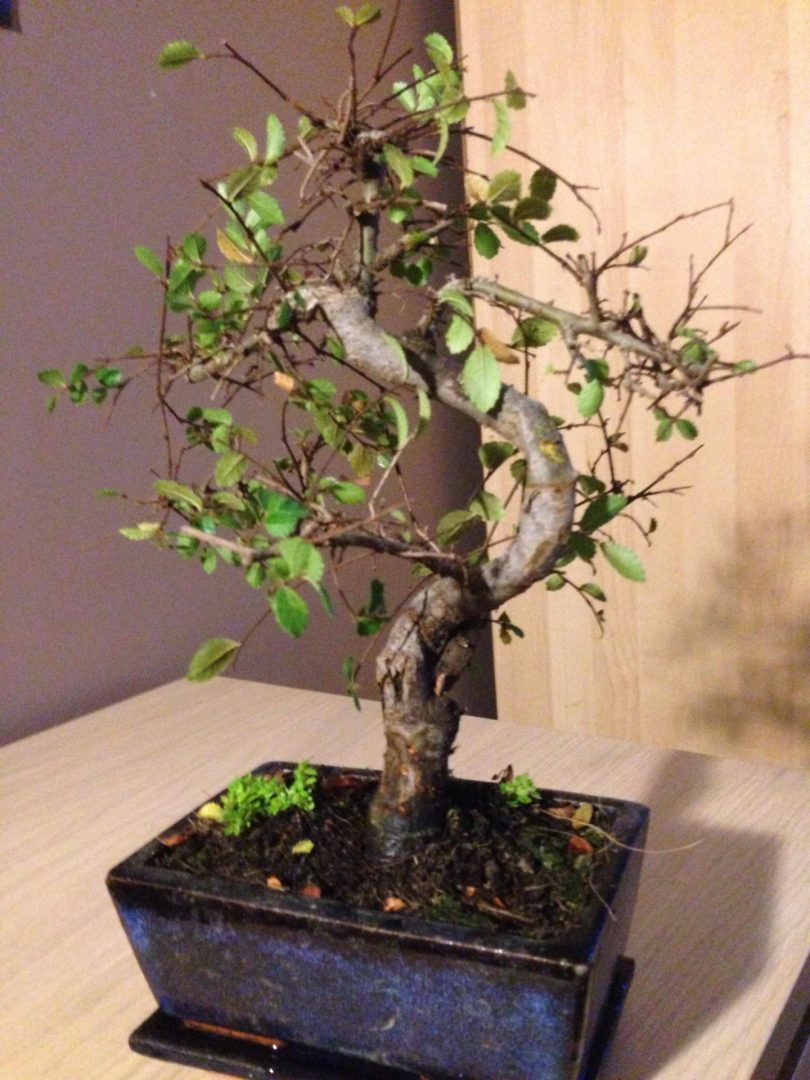
This little tree is so far off kilter it’s in mortal danger. Will repotting help?
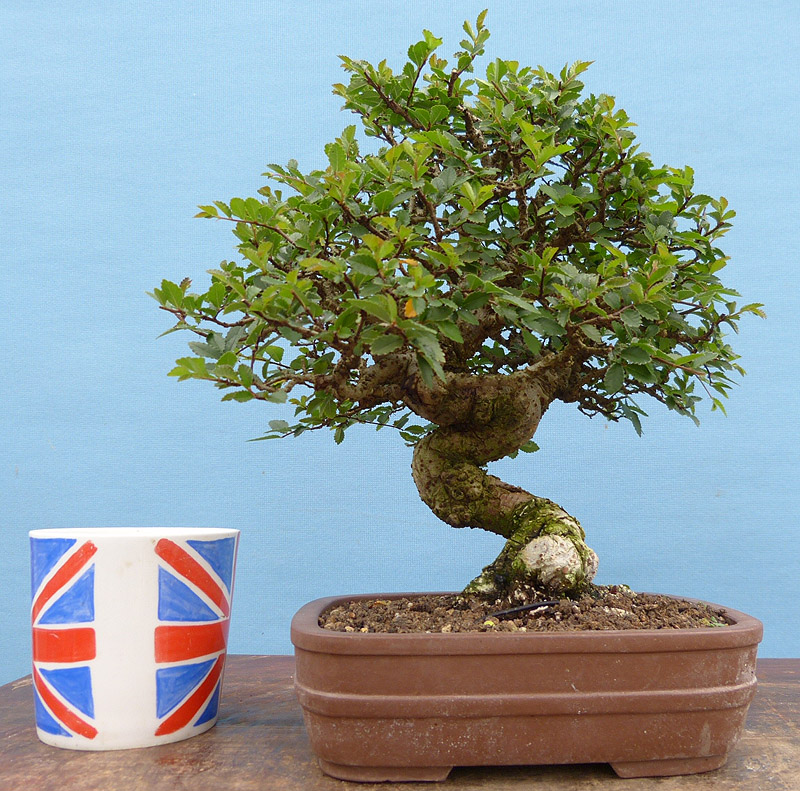
This little elm started off like the one above. It took about 6 years to reach this relatively mature and balanced state and only two repots in that time.
*I actually did that, aged 16, I took the engine out of my first motorcycle the day after I bought it. Therefore I do get the re-potting obsession but I was an ignorant impetuous spotty teenager with a dangerously inquisitive mind and a box of spanners.
So, anybody that knows me, or our business will know we are always busy. Not busy in the sense most of Britain at work is busy. I don’t consider 2 hours work followed by three hours of needless paperwork to be busy. We have one of the lowest outputs per head of working population in the developed world but don’t even get me started…. So we ARE busy, in the sweating my arse off sense. Myself and Richard literally move about 1-4 tons of stuff a day each. Moving between our warehouse and getting stuff packed is HARD work and for a fat middle aged bloke that likes a stogie and a beer that’s exhausting.
Add to that the stress of running a business means I only sleep about three nights a week. That nearly killed me a few years ago and I was rushed to hospital apparently 3/4 dead. Now it’s happening all over again and this current shut down of most everything is not helping. Since the governments actions our order volume has increased about 100%. Soon we too may have to shut down for the simple reason we cannot get any more boxes. All our usual suppliers are shut and there is an EU wide shortage, believe it or not. I’m wondering if I might not get a taste for loafing about and make it permanent. What do you think?
Anyway, sick of people bitching about not getting their goods fast enough. Kaizen Bonsai consists of aforesaid middle aged fat bloke, a pension aged wife, a strapping young son in law and a daughter going on maternity leave next week who looks like she was blown up with a tyre pump. This ragtag little family get out between 60 and 90 parcels in an 8 hour day. My accountant reckons it’s physically impossible for four people to turn over what we do but we HAVE done it for over 15 years now and so I reckon he’s wrong. So to all the complainers, government advice is that you go jump off a bridge and I say amen to that.
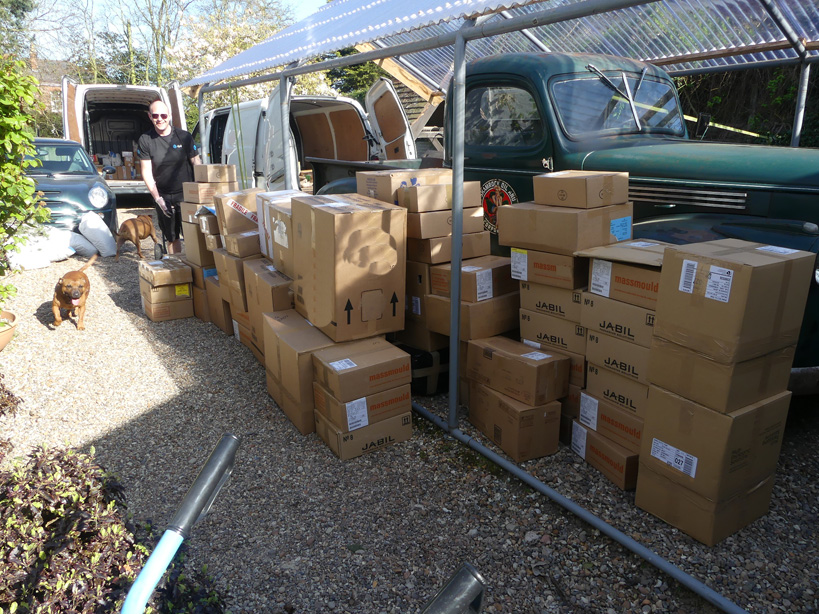
Just so you know I am not bullshitting here is our collection at 4pm today. We started work at 9am. That’s 67 parcels and about half as many (small ones) again that already went by post. If anyone would like to send me a medal I will happily send a signed photo of me wearing it by return.
Seeing as everyone has been shut down for the foreseeable future there are no car boots or bonsai bargain basement, knock it out cheap events going on I figured we could host a bonsai table sale. However that’s not what you think. In fact it is just a special offer sale of display tables. It’s intrinsically against my genetic programming to offer discounts but in this case, through gritted teeth I have to clear out this stuff. Our warehouse looks like some crazy cartoon building that is all distended to the point of exploding. Mr Creosote if you will. I probably paid too much for some of these and now have to take the hit but, such is life in business.
These are a genuine 20% right off the top discount. There are only one or two items of each and the discount is only online for a short time so don’t procrastinate.