Sep 13, 2018 | General
I am always on the lookout for new bonsai trees and good raw material, it is my business after all. Every year it’s getting harder and more expensive to find just the right material at a workable price. Lucky for me I know some great guys and have a long reach. Sadly a lot of those guys are, just like me, getting old and humping great big bonsai trees around becomes a chore. That means occasionally a collection will become available and that’s largely what we have here.
I started into bonsai close to thirty years ago now and how that came about is a long story but there was a wonderful old gentleman involved, a real old school horticulturalist who would have bled sap. His grandfather supposedly came into contact with bonsai in China around the time of the Great War. Upon return home he employed some rudimentary bonsai techniques on the family nursery. His son had much the same experience during WW2 and my friend was the third generation to be bending and pruning trees. Once he largely retired from commercial horticulture I put myself into deep debt to buy as much of his stock as I could, most of the rest went to another friend and bonsai aficionado. Now his advancing years mean those trees have now come to us.

This little juniper was shaped with string prior to WW2!
Today we moved the entire collection of my long time bonsai buddy and fellow Norfolk native. These trees have been lovingly cared for over the last twenty to twenty five years and many are little time capsules and hold fond memories for me. There are a couple that even go back to to the old gent’ that started pioneering UK bonsai in the 1930s. Some of these will not be for sale simply because I am a sentimental old git. I obviously have to sell some or I’ll loose the roof over my head. Here you can see most of the collection and a few other random bits and pieces we bought over the last week. Once I get everything cleaned up and figured out they should start appearing on the web site
G.
P.S. Sorry no prices yet. Please drop me an email and slide the images you are interested into it and I will put you on the list of contacts once I know where I am. There are another thirty trees coming in two weeks time 😉
Scots pine

Scots pine

Satsuki azalea

SOLD

SOLD

Picea a bit sad after the hot summer.

Mugo Pine cascade bonsai tree. Very old bonsai.

San jose juniper bonsai

Shimpaku juniper bonsai tree

Shimpaku juniper bonsai tree

SOLD

Squamata juniper

Mugo pine bonsai tree

Mugo Pine Bonsai

Quince, Chaenomeles

SOLD

SOLD

Japanese black pine bonsai material

Huge carpinus raft yamadori bonsai (cheap).

SOLD

Japanese maple.

Japanese maple bonsai

Yamadori Beech raft bonsai.

Japanese maple

Blaauws juniper bonsai

Large Japanese maple bonsai tree

Juniperus Chinensis

SOLD

Squamata juniper bonsai tree

Fuchsia ‘Mrs Popple’ gnarly old bonsai tree.

Old Japanese shimpaku juniper

Korean hornbeam yamadori

English Oak Bonsai material

SOLD

SOLD

Old Chinese elm bonsai

Zelkova bonsai

Yamadori Taxus bonsai tree

SOLD

English oak

SOLD

Punica bonsai material

Korean hornbeam

Japanese maple bonsai material

Very old Chinese elm bonsai

Pinus sylvestris ‘beuvronensis’ Old bonsai tree

Japanese maple bonsai tree

SOLD

SOLD

Big Japanese maple bonsai material

Carpinus bonsai forest.

Japanese larch bonsai forest.

Wisteria bonsai.

Cedrus atlantica var. glauca. Blue cedar bonsai material.

Cedrus ‘brevifolia’ dwarf cedar bonsai tree.

Azalea bonsai.

Very special Japanese satsuki azalea.

Pinus sylvestris ‘beuvronensis’ bonsai tree, OLD!
Aug 28, 2018 | General
I’m pretty sure I have said it before and, apropos of nothing, I will say it again, I get bored REALLY quickly. I have a short attention span and absolutely hate doing the same thing twice. These are all really bad characteristics for a bonsai wallah. What keeps me coming back (for nearly 30 years now) is bonsai’s infinite variety and the mechanics of constantly trying new things. When I started this business fifteen years ago my parents were dead against the idea and admitted they didn’t think I had the discipline to work for myself. As it turns out I don’t have the discipline NOT to work which sucks as all I ever do is work. Anyhow, before I spiral into a deep hole of self loathing let me get to the point.
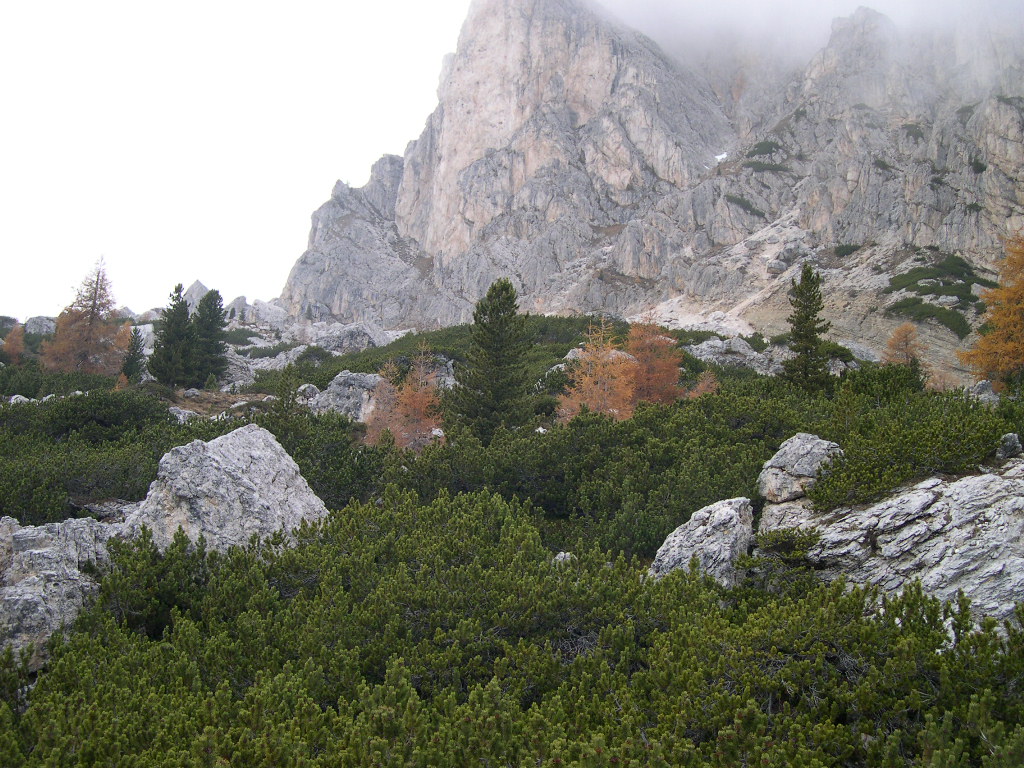
It’s been many years since I got my first mugo pine from the Italian Alps. I have been lucky enough to visit some of the wildest parts of those stunning mountains and the trees I have seen profoundly affected myself and my bonsai. High in the Alps where the air is thin and cold, the sunshine is brilliant and the snow is deep and cold for a large chunk of the year, close to the tree line is the natural range of the mugo pine. Mugo survives where the average summer temperature is just about 10° C and winter temperatures drop to below -30° C. Snow can pile up several meters deep compressing the flexible pines into incredible shapes. During the spring snow melt huge chunks of compacted snow and ice can wreak inconceivable havoc. Add to the mix possible rock falls and 100mph wind speeds laced with ice crystals and sand and you have the crucible in which bonsai magic is formed.

The Italian Alps, the home of mugo pine trees.
Over the last fifteen years I have been privileged to have a lot of mugo pines. Sadly most passed through my hands pretty quickly and I have never entirely got to grips with the species in the way I have with other types of pine used for bonsai. On balance I have relied on the wisdom and experience of others and the underlying horticultural “wisdom” we tend to accept as being “gospel” in bonsai circles. However, on balance, this has let me down and the results are some fairly spectacular failures and heavy losses equivalent to being hit by a train. Like they say it’s not how we fall down but how we get up that defines us. In Bonsai, dead trees are inevitable, it happens, most often those deaths can be attributed to what we have done along the way. However if we are folk of honour we will acknowledge our mistakes, suck up the loss and give the fallen tree the respect it deserves by learning from it’s demise and not being so stupid henceforth. A man who never made a mistake never made anything and mistakes are the price of an education. Education costs, simple. Sadly many folk in bonsai are not prepared to pay for education seeing the value as limited. Having spent the last thirty years obsessively cultivating bonsai I have my own opinions about that.
There is only one source of wisdom in bonsai, it’s not a forum, a book or a fat bald bloke with a beard. The only place we can learn how to grow our plants is from the plants themselves. Everything we need to know about bonsai is written in plain sight right there in the pots on our benches. The trouble is most of us don’t speak “tree” and because most folk think the cultivation of bonsai is in some way different, special or more complicated or involved that other branches of horticulture the beginner is on the back foot right out of the gate to mix my metaphors. In this modern age of oppressive health and safety it’s impossible to do anything at all without training. We even need to be shown how to handle a hot beverage and lift a heavy box, WTF. But any idiot can go out and buy bonsai trees, often very expensive ones, without showing they have the required skills. Then, once it’s all gone horribly wrong they come back demanding a refund because i am such a despicable low life crook.
Mastering the cultivation of bonsai trees requires a deep understanding of horticulture. Plants need light, air, water and a growing medium that’s suitable for it’s roots and that’s pretty much it. We make our lives tough by using unfeasibly small pots that, most of the time, do not have the required amount of root in them. By and large we make it almost impossible for our bonsai to thrive because we are constantly pissing about with them. I have always said bonsai happens when we are indoors watching TV. Our constant poking and prodding just upsets our trees and in many cases ensures they will never become bonsai. Up there in the Alps there are beautiful examples of naturally dwarfed and stunted trees that can make you burst into tears and cry like a little kid with a crayon stuck up it’s nose. I have lost count of the number of bonsai collections we have purchased over the years, many from thirty plus year veterans of the hobby. I can honestly say that I have been close to tears over many of these occasions at the tragic sadness of tortured trees fighting to survive. If we don’t stop the nonsense and start to learn our horticulture properly sooner or later somebody is going to ban bonsai because it’s cruel and so they should. Bonsai is considered an art form because that’s what we make it. A lot of what I see is the art of the torturer. What other art form is created at the expense of it’s subject?
So, getting back to my point. I have not had great success with mugo pines in bonsai cultivation. Sure some have done well but some have not and until I see 100% perfection I will not be happy. There are a lot of factors to consider before we can take a step forward with any wild collected tree. Firstly I live at sea level in the UK. We have largely cool summers but 20°C is double what a mugo normally sees. We have mild wet winters, the opposite of what a mugo has in the mountains, frozen dry conditions. Even in summer on a crystal clear day our light is weak in comparison with the brilliant high UV light experienced at ten thousand feet altitude. In the mountains the growing season will likely begin in late May as the snow recedes and will all be over by mid-September. Those factors alone should make us wonder if keeping a yamadori mugo pine is even possible.
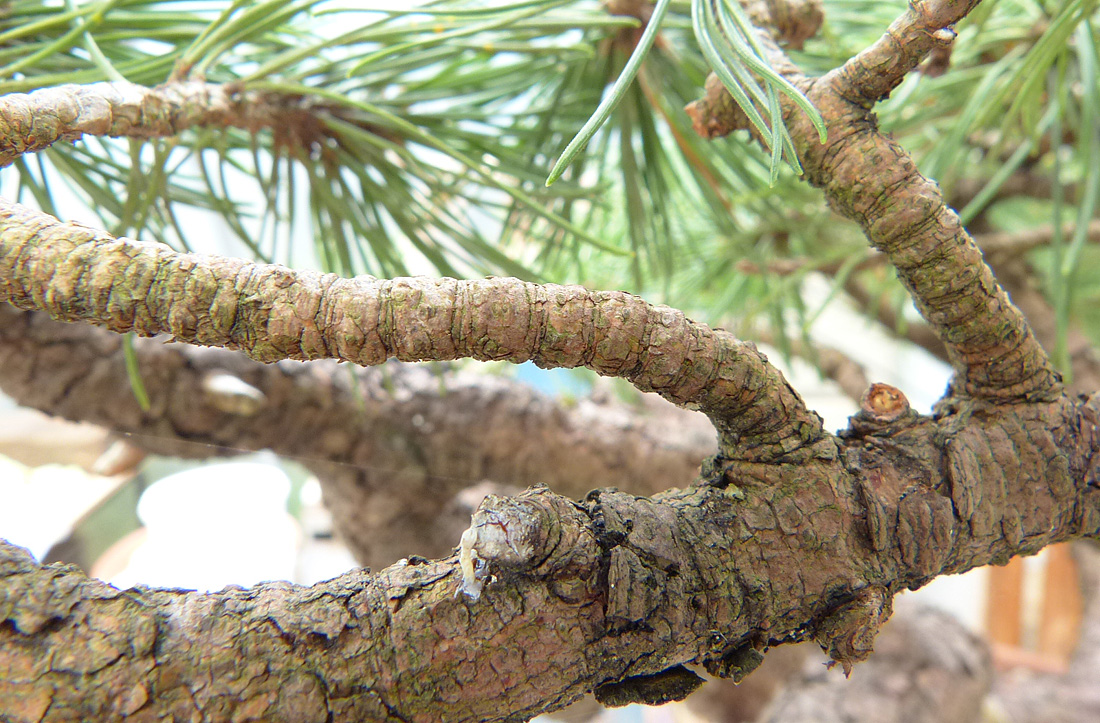
Take a look at this picture……
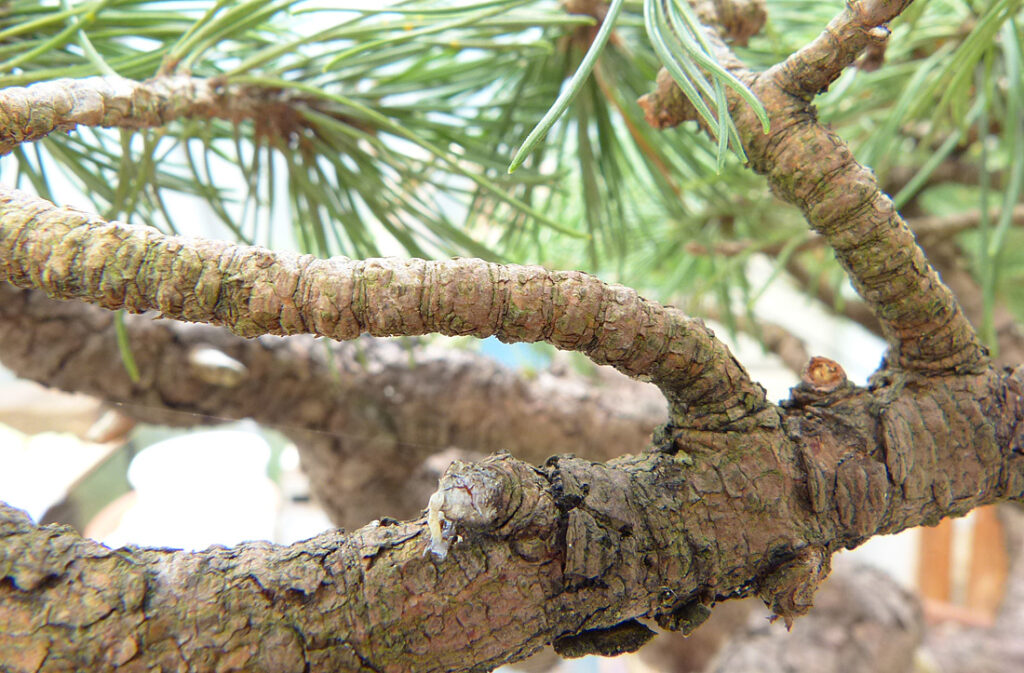
Growth rings on a mugo pine.
That twig is about 6mm diameter and each segment is about 6-8mm in length and represents a years growth. That’s about fifteen years to grow 10cm. This tree has a 5″ diameter trunk so go figure how old that might be. I came up with (assuming a consistent growth rate) something from 317 to 448 years so lets go nuts and say this tree is two hundred years old.
There is not much soil in the high mountains. Most mugo actually live in their own needle litter, some moss and a bit of grit and sand that blows in. There’s not much in the way of nutrients and in summer not a lot of moisture around either. A root will follow a crack and pick up what it can where it can. Research has shown that often a trees root system can be meters away from the actual tree in a pocket of dirt somewhere else. Therefore collecting one of these is always going to be a bit hit and miss unless you pick it out of a pocket with most of it’s roots in tact. All things being equal we have to concede the odds of keeping a mugo pine alive and actually creating bonsai with that pine are pretty long. On a bad day I would say there’s no chance but look agin, what does the above tell us about mugo pine? It’s pretty tough, right? Just one proviso, mugo are extremely tough and can survive where most others can’t but they don’t move far, in fact they don’t move at all. Much like me getting a mugo to a different place and making us happy is a big ask.
So having spent more than a decade trying to get the best of the mugo pine I was struggling to see where I was falling short. Re-potting only when the tree began making strong growth after several years. Re-potting in late spring once the buds were open. Alkaline soil mix with a lot of pumice and bark to mimic the natural soil. Top in full sun and pot in the shade. Limited use of fertilisers, dry cold winter conditions. Very little pruning and lots and lots and lots of waiting and waiting and waiting, these are very old trees! My mugos were growing but were never doing what I just know they are capable of.
Last year I pulled out a mugo that had been knocking around here for more than five years. I got into it at the wrong price and to be honest it was crap. A three foot straight trunk with a knot at the top, no nebari and no deadwood. Looked like a pissed spider balanced on a cocktail stick. Having had dozens of ground layered mugo pines I figured out an air layer would work and so around April time I stripped a ring of bark and wrapped it in moss and cling film in my tried and tested manner. Nothing happened all summer except the tree growing well as normal. Then around mid-August in just four days the moss filled with fat white roots, looked like a jar of beansprouts. Incredible, less than a week and we had a pound of fresh roots. Around the end of August I unwrapped the plastic, cut up a plastic pot and cobbled that around the trunk in a haphazard fashion before filling it with soil. I then put it back outside in the sun and left alone.
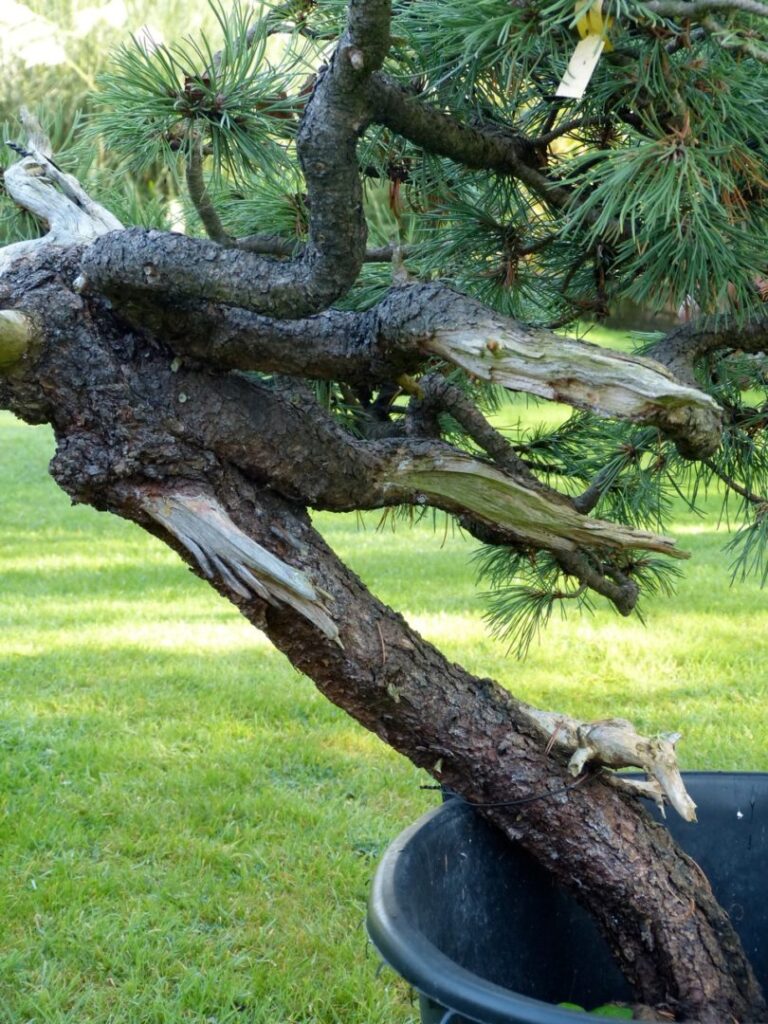
Mugo Pine. They don’t come much uglier than this. Spring 2017 prior to air layering.
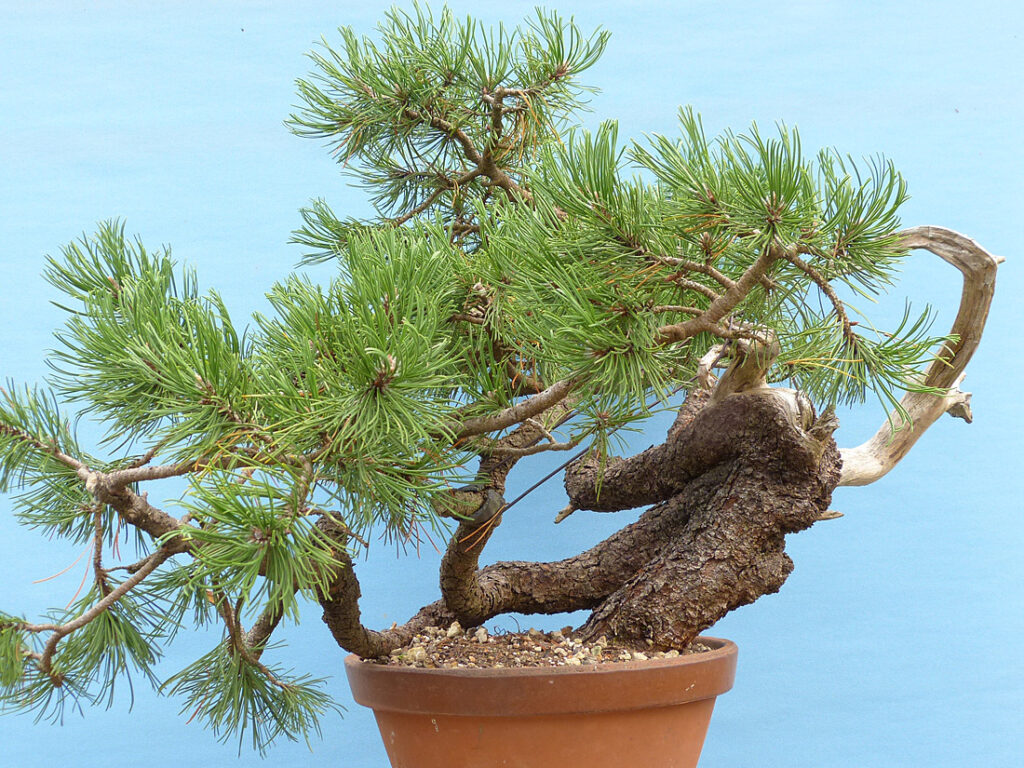
August 2018 successful mugo pine air layer.
This late emergence of root got me to thinking. As an experiment we decided to re-pot a massive mugo that was growing in a bath tub of a pot. This huge tree was growing well but once we got into it there was very little root and by the time we got it bare rooted there was about 5% mass compared with the foliage. Undeterred we potted it up into pumice and bark, secured it into the pot well and put outside in the sun. A year later the tree is growing like a weed.
The cold winter of 2018 was perfect for mugo pine I guess. Come the thaw and spring flush my newly rooted mugo air layer grew better than ever. By summer a little Green Dream around my makeshift pot was my only interference. By mid-August I was curious to see what was going on and a poke around in the pot confirmed it was full of root. I decided to cut it off the stump but once in the workshop I was surprised to see the bark falling off the original trunk. In just a year the tree had created a mass of new root and jettisoned it’s old root system itself. Now potted into a terracotta training pot we will see what happens in the future. The other big lump we re-potted is doing well too.
Thinking hard about this, as I have for a year now, I remembered being in the Alps around early May one year. There was still a lot of show around and it was horribly cold, just a degree or two above freezing in the middle of the day. In one spot of deep snow I could see the tips of mugo pine sticking up in the snow, the rest of the tree was completely buried and frozen. On those tips were little tiny candles of new growth, actual candles that were pushing through the surface of the snow. At the time I didn’t really think much of it, I just marvelled at the determination of the mugo pine.
Think about what we ‘think’ we know about trees. By and large things are dormant in winter. Come the improving weather roots begin to grow before we begin to see the evidence in swelling buds and eventually new growth. We also believe that roots feed the tree with nutrients and water from the soil so roots grow to fuel top growth, right? I certainly think so, by and large (without going into too much detail) but not all trees are the same. Wherever there is a water source and light you will find some kind of plant or tree that can survive there. When you get to the tree line in the Alps you will find mugo pine, pinus cembra (a type of five needle white pine)a few larch and spruce along with some ground cover willow. So if all trees were the same how come there are no maples up there? Just because a tree has roots at one end, leaves on top and wood in the middle it does not mean it’s the same as all other trees. Trees all have their own unique coping mechanisms and occur where conditions suit them best. A ficus wouldn’t last long in the Alps and a mugo pine wouldn’t last long in the tropics.
My conclusion so far is this. Whilst a mugo is frozen in winter it’s resinous sap won’t freeze. The thick bark of the pine and soft open wood structure allows the tree to store a lot of energy and moisture over summer and this is used in spring to fuel new growth as the roots are still frozen solid. This gives the tree a head start in the short growing season. By mid-summer the new growth is soaking up energy from the sun and this is passed back into the tree for storage for next year and to fuel new root growth which goes on until the soil once again freezes.
When we re-pot bonsai, or pot yamadori for the first time we have to time the work correctly. Ideally a few days before new root growth begins we can jump in. As soon as we have finished work, root development will get under way. This gives the root mass and the tree overall the best chance of a fast recovery and a favourable outcome. If the survival strategy of a tree or it’s natural rhythm of growth is out of sync’ with our silly notions what chance do we have of success? Hot weather trees go dormant at the height of summer which for a ‘little Englander’ is a bit hard to fathom. As an example ficus and olive do best re-potted at the height of summer in mid-July. If a mugo pine is naturally still frozen solid during our traditional re-potting season of March-May why would we think it should bow down to our convenience. Evidently mugo pine in the UK make root in August and so far, having re-potted a half dozen large and very old trees it appears to be working wonders.
This process of working out what plants need and how I need to change my techniques and approach for their well-being is what keeps my interest alive. Learning to speak Bonsai Tree is what we should all be focusing upon, the other bits of bonsai are pretty simple by comparison.
G.
P.S Just because we are re-potting a tree why do we assume we have to root prune? With yamadori particularly at the first or second re-pot the only reason to root prune is if you can’t get all the root into your pot. If that’s the case think carefully about the size of your pot. Putting a tree in a bonsai pot does not make it a bonsai, in fact it often ensures that tree will never become bonsai.
Jul 26, 2018 | General
I have a lot of stuff, much too much stuff. I was poking around in the warehouse earlier and noticed we have a lot of interesting stones that have been sitting around for a while. I hate slow moving stock so I thought we could have a sale! (wash your mouth out with soap Potter!).
These are genuine, and some are massive, discounts and i’m hurting. Some of these special prices are less than we paid so grab a bargain before the heat-stroke wears off. Discounted prices will end on 26 August and won’t be repeated.
G.

Jul 25, 2018 | General
WARNING: Sage advice about bonsai preceded by strong opinionated nonsense. Don’t read if you are sensitive to such things.
In spite of my continual bitching and moaning there are some good days here at KB. Having a dark and twisted sense of humour the things that make me smile are not often to be shared with those outside my inner circle, they are pretty much beyond shock or offence. Good days will always be more frequent when the sun shines and we are getting plenty of that and it’s wonderful. I won’t waste a single minute of it.
To that end I was hacking through my inbox at 5.30am. The earlier I start the earlier I can get outside. Even before I had a chance to neck my first coffee the crap started when my internet connection failed miserably. Now I appreciate I live in the middle of a cabbage field and all us folk from Norfolk are considered a bunch of clod-hopping carrot crunchers but our money is still good and I get a bit naffed off paying for a service that’s so appalling. Serves me right for living in an aspiring third world country I guess. For such a bunch of ingenious folk we have become a shocking shambles. It seems we remain pretty good at drinking and fighting and if there was a world cup for bitching and moaning no other country would even get close. Engerland, Engerland!
Having had my early efforts at work thwarted I thought I would pop the TV on and catch the news. That in itself could easily make a TV show. Picture it, a fat old bloke sitting there all on his own in holey kecks, covered in toast crumbs ranting and raving at the TV like some Alf Garnet prodigy. My frustrations know no bounds but I do enjoy blowing off some steam and it sets me right up for the day to come. Today, unusually, I was pretty much reduced to tears of laughter.
Somewhere along the way our esteemed BBC claimed the moral high ground and became the self appointed bastion of moral standards and good advice. By and large the BBC early morning news output is so far behind the rest of the world it’s shocking but they are too daft to notice. “Impartial, free and fair” said Jon Sople to president Trump who replied “Yeah. Sure.” The BBC promotes itself as Britain’s most trusted news brand which is pretty much giving everyone else the finger in a very polite public school sort of way. I have had to stop listening to BBC output pretty much but today was an absolute classic. The presenters were doing their usual hand ringing worried face, ‘were are more educated and smart than you’ routine, spewing forth sage wisdom to us poor dumbass, country as a chicken coop, hicks about the dangers of hot weather. Basically everyone in Britain could be dead by Friday because it’s warm and we are all too stupid to come inside out of the sun and who knew we had to ‘hydrate’. Hydrate!? Don’t you mean drink something! What next? If you get hungry eat something? Just make sure it’s fat, sugar, alcohol and nicotine free.
After giving their sage advice they cut to some folk in a park in London and where interviewing a bunch of knuckleheads about how they were coping. Some twit said “oh I like to sit in the shade” someone else noted sagely it was actually cooler in the evening or early morning. Next they spoke to a pretty girl out at lunch sitting on the grass who, as I recall, said something along the lines of “This isn’t hot at all, i’m from Africa, I wouldn’t call this a heatwave, it’s fine.”* That made my day 🙂 Take your nanny state and shove it in the shade! I have been outside in the sun and I am no more dead or nuts than I was when I got up this morning.
Brit’s do love to whine, especially about the weather and I am always in that queue. They are forecasting over thirty degrees all week which is chicken shit, that’s not hot, sure it’s warm, it’s nice and warm and what’s up with that, it’s summer? Today I spent two hours in my greenhouse and here is what the thermometer said just before lunch (and no it’s not broken).
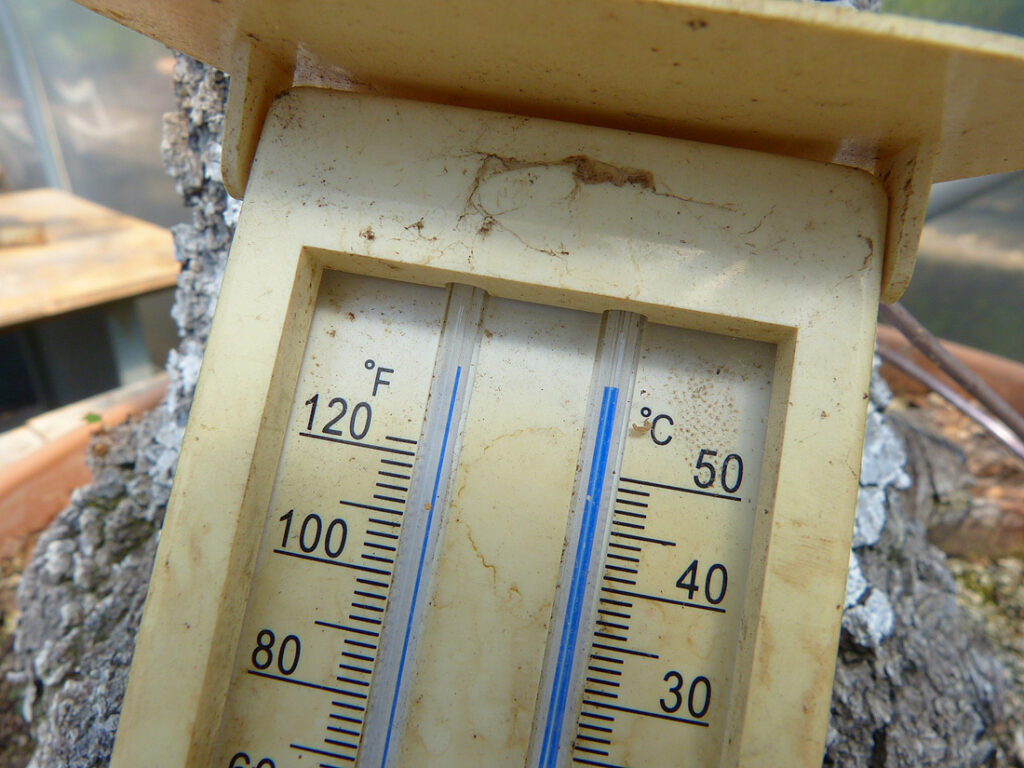
Now that’s warm! Peachy.
As people who keep bonsai, this time of year can become a bit tedious. Plants need regular ‘hydration’ and when it’s pleasantly warm our small pots do present a challenge. Most of the time in the UK a good watering once a day is perfectly adequate. However during sustained warm conditions trees will often dry just that bit too much. At this time of year it’s advantageous to water twice a day (four times a day in my greenhouse), once early in the day and then again in late afternoon. Around here I water at 9am and 6pm. the morning watering seems a bit pointless as trees are still damp from the previous evening. The significant point is that damp soil absorbs moisture more readily than if it is very dry. Watering twice daily is actually faster because the damp soil will absorb more water much faster meaning less soak time and no need to come back over a very dry pot multiple times. This will give your bonsai an easier ride by providing, as far as is possible, an even and stable condition with good cooling water supply all day. You will actually be using a lot less water too with this method because there will be less run off. That is important if you are having to hump watering cans because you are suffering a hose pipe ban. Obviously come cooler conditions things change again.
Talking of hose pipe bans I saw that some authorities are losing up to 25% of their water due to leaks. My Dad spent thirty five years working for British Gas on large distribution mains and by and large they didn’t lose anything. If the gas folk can do that I think it’s about time we put a size 10 up the water authorities don’t you? I went out of my way to buy a property with a water well. Come the day the drought Nazi’s knock on my door I have a convenient place to put them.
To sum up, don’t get hot in the sun, don’t let your skin sloth off, don’t wear winter clothes, don’t put your bear ass on a hot plastic chair that has been in the sun all day and do keep those trees hydrated. Sound, sensible advice bought to you by Kaizen Bonsai!
G.
*Perhaps the BBC is “Impartial, free and fair”.
Jul 20, 2018 | General
WARNING: The following diatribe includes personal opinion. If you are easily offended by opinions other than your own please don’t read any further. If you are minded to leave hostile comments or would like to tear me a new one I could’nt care less. Last time I checked I am still entitled to my own opinions (and this is my blog), what follows is based entirely upon my own opinion and the experience upon which it was formed.
I am on the horns of a dilemma. As is the way of these things the issue has been developing over time and has now come to a point that requires some thought, discussion and possibly even a decision to be made. Earlier today my daughter discovered a wasp nest in her bedroom as you do, it’s in a built in storage area under the eaves of our thatched house. It’s the size of a football and until this morning there was absolutely no sign it even existed. Trouble is it’s actually less that two feet from where she lays her head down at night. Personally I would leave well alone, there are no wasps in the house and so long as we don’t go poking it with a stick it’ll all resolve itself by Christmas. She’s not so keen so the extermiantors are on their way.
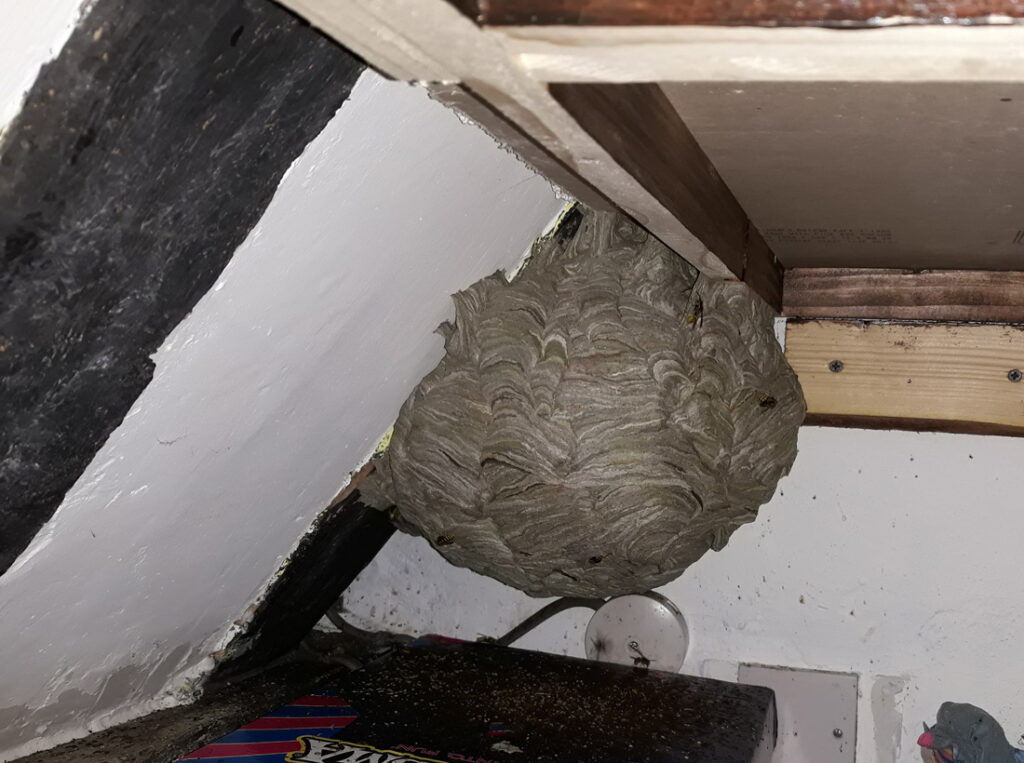
2000 critters living in the cupboard.
This evening I was outside in the sunshine watering as I often am at this time of year. As I went about my business a little brown wren popped out of one of my trees and sat two feet away from me on top of the fence with a lace wing in it’s beak. It sat there watching me for a while before disappearing into another of the large trees where I could just see it hopping from branch to branch looking for more prey. This got me to thinking but before we go further let me set the stage.
We are privileged (via a lot of hard work) to own a 400 year old thatched house. It’s the last house in the village next to acres of fields all bounded by ancient hedgerows. We are only a mile away from the Norfolk Broads reserve and less than two hundred yards from areas of ancient fenland, endless marshes and tidal mud flats. Our half-acre plot is entirely surrounded by very old hedgerow of mixed native species from holly, prunus, hawthorn, yew, a few modern conifers and the like. There is ivy everywhere and some of our hedges might be considered a tangled mess. In the garden are a couple of mature forty-foot larch, massive cherry trees, a 150 year old oak tree and a fifty foot scots pine. One of our boundaries consist of four hundred year old limes, a couple with trunks as large as a small car. We have a couple of ponds we have turned over to natural management (left to their own devices) that are breeding grounds for the fish that live in them. In spring we see more than fifty balls of frog spawn every year and they also support toads, newts, a great number of varied dragon flies and wildfowl including ducks who have raised broods here several times. I am no twitcher but we have nests of robin, wren, blackbirds, crows, pigeons, doves, magpies and a variety of finches and tits. We regularly see several different birds of prey and can hear owls at night. We see the occasional rabbit, squirrels, mice and sometimes a muntjac deer will wander in from the lane outside. I have seen common lizards and a grass snake as well as two daft Staffies. There really is a lot going on here despite it being fairly quiet.
I am 54 years old this year which means I come from simpler times. A time when common sense was just that and when hysteria was pretty much unknown, stiff upper lip and all that. I was raised by parents that went through the war as children and by their parents that kept a cool head and appreciated just how blessed they were to have a roof over their heads, food on the table and were free from the threat of death falling from the sky every night. Simple pleasures by todays standards which are often taken for granted. Every single day I am shocked by the stupidity and hysteria that has infected our once proud country. I fear it’s all going very wrong and that we will never be able to get back. Just think about how modern Britain’s would deal with what our grandparents had to deal with in 1939. Many Brits’ have gone soft in the head and we may have become a nation of dependant whiners incapable of dealing with life ourselves, taking responsibility and largely incapable of intelligent thought. Everything has become somebody else’s responsibility, the universal cry is “The government should do something ….”. Well, surprise, surprise, I DO NOT AGREE. The government and authorities are incapable of holding everyone’s hand and mopping up after them, in fact governments are incapable of much other than wasting money and cocking things up. If governments are our only source of help then God help us all, we’ll need him.
Bear with me here I AM getting to the point 😉 My big issue is with ignorance, it seems to be infectious and since we all got access to the internet ignorance has increased a lot, in fact since the time we all got our first dial-up modems the spread of stupidity seems to be relentless. Lately what’s been called ‘fake news’ has pointed a spotlight on the fact a lot of folk do actually believe the shit they read or are told online or via a million forms of media streaming into our heads 24/7. As a bonsai artist and a business man involved in the bonsai trade I have to say I am on the verge of leaving and going back to my first love, motorcycles. EVERY SINGLE DAY I am bombarded by frankly quite incomprehensible nonsense and trying to stop the tide like some King Cnut come lately, and educate, what feels like the whole world, has literally sucked the life out of me. I have never been so tired, depressed and lethargic, only my bikes are keeping me alive. Kaizen Bonsai may just be for sale but after reading this you might look away.
As an example to illustrate my point, last summer I sold a pretty little cotoneaster to a “lady” here in the UK. Not an expensive tree, just under £100 including the VAT and delivery. The lady bought the tree from our web site where it was listed under “Outdoor Bonsai Trees”. We shipped it and never heard any more, they say no news is good news and so we thought no more about it. This was around August time. Come October I got an email asking for my advice as to why the tree was not growing. I asked the logical questions about what she had been doing and where the tree was kept. I was told the tree was indoors on a windowsill and since the heating was turned on the tree had started to look poorly. I replied that it needed to be outside year round and what was she doing in regard to watering it. The reply? This is a direct quote! “Oh I didn’t realise I needed to water it”. After I returned from sticking cocktail sticks in my eyes I had to wonder whether my life was really worth anything at all. I did my best to be polite, anyone who knows me well will be grinning about now. After I pointed out her error she went on the attack calling me a crook, thief, charlatan, bandit and some other choice phrases I will spare you from. She then complained to Paypal who took the money off us and gave it back to her. This sort of shit happens almost every day.
Many bonsai folk have sadly fallen foul of the modern epidemic of hysterical silliness bought on by shit, published online by ill-informed, ignorant, unqualified, inexperienced idiots keen to look clever and pick up followers, friends, subscribers and generally be the centre of attention, nowhere is this more evident than in relation to the subject of pest and disease (P&D). The hysteria regarding bugs, fungi and bacteria leaves me completely speechless. I was once excoriated by a guy that re-potted one of our trees a year after he bought it because he found a single vine weevil grub. Bearing in mind these are endemic across much of Europe and will be found across the UK living in grassland and turf you ARE going to bump into one of these little guys from time to time. If you are growing soft tissue plants like Huchera or bedding plants in multi purpose compost and they go unnoticed there may well be an issue but if you grow bonsai trees in modern soil mixes they really will not be an issue worth worrying about and besides, how much of the contents of a 20” pot can a single 8mm grub possibly eat? If your bonsai get to a stage where there are a thousand grubs in your pot and a plant starts to suffer I would suggest you might want to pay more attention going forwards.
My issue is this. My little wren has a nest in our garden alongside a dozen other nesting varieties. Due to careful consideration we have a thriving eco system all around us. We have more bees than you can shake a stick at (and wasps in the roof), butterflies and literally thousands of species of insect. Many of those insects rely upon plants for their existence and many of them would be classified as “Pests” within the bonsai community. Some ill-informed individuals believe bonsai trees can ONLY exist in a sterile environment free of contact with fungi, bacteria and insects. I know this not to be true but in order to furnish such folk with squeaky clean trees should I bust out the chemicals and destroy a beautiful eco system that has evolved around our old house over four hundred years? If I worry about a few aphids (greenfly/blackfly/whitefly etc) and adopt a scorched earth approach to their eradication my customers expectations of a sterile bonsai tree will be largely realised but without those aphids I won’t have lacewings and the like and then my little wren won’t have the food source he needs for his young family.
Just today my good lady was fussing over the trash bin outside that has maggots crawling around in it and is full of condensation due to the warm weather. Inside the lid is absolutely alive with tiny maggots. What can we get to destroy these? My advice was to open the lid and leave well alone. Within ten minutes there were robins and other small birds having a feast. Perhaps surprisingly the world needs flies that come from maggots. Birds like robins eat maggots and birds like swallows eat flies and maggots eat rotting crap we do need to dispose of and what more responsible way is there of doing that?
Here’s another thing that bothers fuss pots. Slugs and snails, not my favourite thing but they do love a bonsai garden that’s constantly being watered and has lots of cool damp pots to hide under. I used to put out pellets to try and clear them until one day I found a hedgehog laying in the middle of the lawn. It wasn’t dead but it certainly wasn’t alive either. I had poisoned it with my slug pellets (via poisoned molluscs). After about a week of care it did recover but was a close run thing. Toads and frogs eat slugs and snails too as do thrushes that we have in the garden and when was the last time you were overrun with those? They used to be everywhere when I was a kid. What nine year old boy didn’t love to watch a thrush beating a snail on a rock? Sure if you are growing lettuce these slimy creatures can be a nightmare, so plant more lettuce and share and don’t poison all the predators and then you won’t be overrun with a slow-moving plague.
Thanks to my mother I have an inbuilt fear of spiders. I live in an old house and so spiders are a way of life. All my life I tried to rid my space of these pesky critters. One thing I refuse to do is be a slave to fear and so for a couple of years I worked hard to make my peace with spiders. Rather than pounding them into the carpet now I either let them run off or put them outside. For several years in summer time we were annoyed by little black flies buzzing around in the house, these are impossible to swat and extremely hard to ignore. Last summer I noticed a patch of spider web had appeared in the corner of our living room between two of the beams. It gave me the creeps when I saw two black legs sticking out of the hole in the middle and whilst watching TV from a safe distance I actually became quite enamoured with my new buddy. After a while there were no more flies and in time I guess the spider died or moved on, I kind of miss him now and the flies are back.
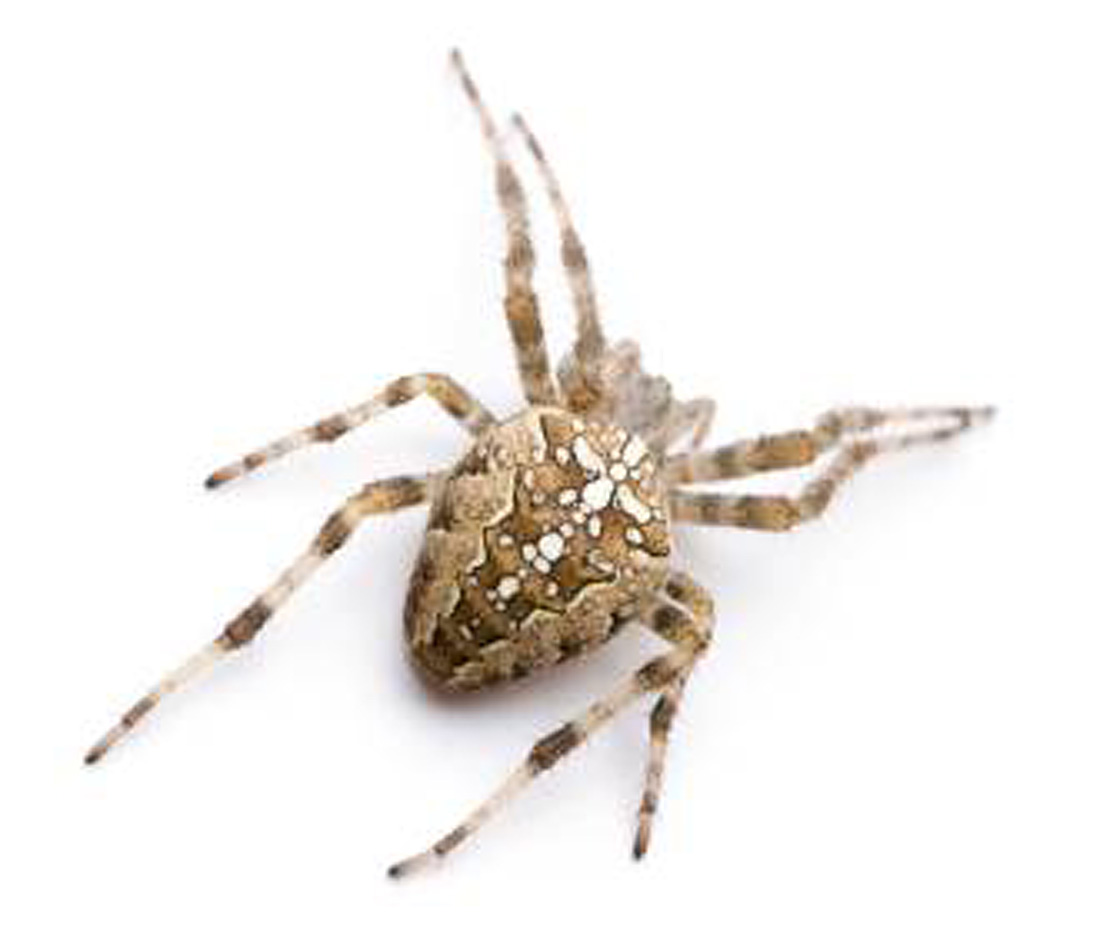
One of my biggest fears, since I was a kid, were those big fat bodied spiders that appear towards the end of summer. Apparently they are called European garden spiders (Araneus diadematus). Nasty looking fat bodied brown things that often end up looking like a marble with legs wearing a fur coat. Late summer every year and these would be setting up shop in our greenhouse and just giving me the chills. One year in a spirit of cooperation I decided to stop smacking them with a plank or spraying them with insecticide as I had done for years and just let be. The result was a lot less annoying critters in the greenhouse and cleaner plants, the greenhouse was also becoming a feeding ground for small birds again.
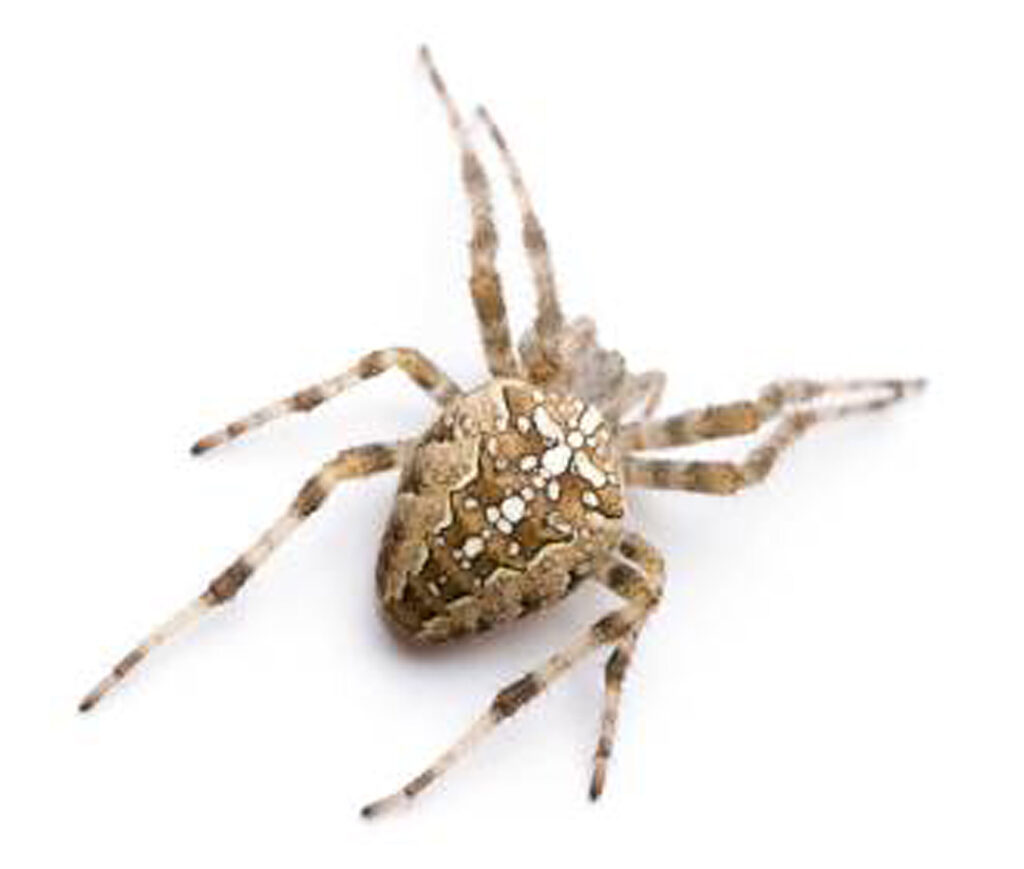
Fantastic pest control!
So, now hopefully you begin to get my drift? A while back I wrote along these lines in relation to soil What should be in your bonsai soil. Progressing on from there I have become increasingly aware of the responsibility I have to the little bit of the world I temporarily own. The dilemma is fairly plain, do I wreck everything like an angry bull in a china shop just to satisfy a few ill-informed folk? A blanket use of chemicals will destroy the whole show and probably go some way to poisoning me too. Chemicals are not selective they kill all the pests.
I am acutely aware that some pests do need to be controlled. See my blog post earlier this year about a pesky fungus bothering junipers . As I will explain P&D can get out of hand and particularly where something comes from foreign climes problems can occur. Again hysteria in this respect is rife but often unfounded and ill-informed. Much like the media going into overload about ash die back and blaming it on plants imported from the European mainland. This did massive damage to the nursery and garden centre trade. P&D are no respecter of national boundaries and ash die back has been making it’s way steadily here for a long time and it’s arrival was inevitable with the right east wind. The crazy thing is that more ash trees have been destroyed in an attempt to control the disease than have actually been killed by the disease itself. If a fungus is killing trees where is the sense in killing ALL the trees before it gets there? Truth is authorities are terrified of another Dutch elm scenario on their watch. Sure we lost most of the big elms but there are survivors and resistant strains are now being cultivated and ulmus procera are literally everywhere in southern Britain, sure they don’t get big but everyone in British bonsai loves them, I have two dozen myself. Often times these issues are little more than political footballs kicked about between the media and those same feckless (keen to be re-elected) authorities.
In spite of what some folk tell me I am not actually classified as stupid or whatever the modern parlance is for that term, though I do have my moments. Nobody wants to buy a tree infested with bugs. That’s not what I am talking about here. My point is it’s IMPOSSIBLE to have a plant that’s 100% free from any form of life other than plant. That is unless you submerge it in a vat of pervasive chemicals and then seal it in an air and water free vacuum. The way some bonsai folk run on you could be forgiven for thinking that is exactly how bonsai trees should be kept. Truth is that cosseted and mollycoddled bonsai trees are noting but trouble. Expose trees to the elements commensurate with their natural habitat, do not water or fertilise more than is necessary to maintain healthy growth and just let the tree do its own thing with an absolute minimum of your fiddling and trust me you will be surprised with the results.
Over the last fifteen or twenty years I made the mistake of making myself available to anyone who wanted my help and advice. Each year I spend over a grand paying the phone charges for people who call me for free advice that takes close to a day a week of my time. Clearly that won’t be continuing, especially as I am suffering abuse from some idiots who call me and don’t like what I have to say. Having done all that, one fact has become VERY obvious to me, 99% of ALL the problems experienced by bonsai trees are the result of the actions of their owners and, or, the owners perception of what may, or may not, be an actual problem. In the UK I have almost never experienced, or seen, or heard of a significant problem with bonsai that was caused directly by P&D that did not have an underlying issue related to the trees care in some way. That’s not to say problems can’t just spontaneously happen but it is very rare in my experience.
Much like us, plants have inbuilt defence mechanisms to help them survive in a hostile world. Much like us, where a plant is fighting fit it will happily resist the advances of P&D. However, get tired and run down and you are asking for trouble as I found out to my cost when I ended up in hospital with pneumonia. Living in a bonsai pot is a stressful situation for any tree no matter how good your horticultural skills. Wildly fluctuating temperatures, limited resources and imbalances caused by pruning and the like all make for a stressful time. Thankfully most species are super tough and just shrug this off and the stress serves to make the plant even tougher just as the stress of weight training will make you stronger. But, given time, constant stress will always prevail and cause problems, especially if we miss the almost imperceptible telltale signs of things beginning to go out of whack. The first many of us know that things are not what they should be is when we notice a pest attack or infestation. We blame the pests for the problem of damaging our bonsai’s health when in fact they are a secondary issue to an underlying problem, often of our own making. A few critters on a plant is perfectly natural an infestation (the state of being invaded or overrun by pests or parasites) is not. A few pests will not, in regard to a healthy plant, normally result in an infestation. Nor will a few bugs harm the health of a tree.
I have had folk call me, absolutely beside themselves in blind panic because they found a few leaf munching caterpillars on their bonsai. Much like the vine weevil how much can a few caterpillars eat? Well actually quite a lot but if you have the eco system around you they won’t get out of hand, much like our bin. Consider what a few caterpillars eat and then look at what’s laying on the floor after you have given your beloved bonsai a summer prune. To some, a few munched leaves will spoil their enjoyment of bonsai entirely. Personally I like to know my bonsai are accepted into the natural world and are providing a living for the inhabitants of my garden. Perfection is an impossible target in bonsai and the pursuit of that perfection has seen the disillusionment and demise of countless potential bonsai masters over the years I have been around. I got into bonsai first and foremost because I love trees and that means I MUST love the environment in which those trees live and that environment includes a lot of wildlife and that’s a part of what makes a tree such a magical thing surely?
I was recently listening to a radio program about gardening and there was a question about honey fungus, something that causes utter panic amongst gardeners. The expert was a senior gardener at the RHS’s most famous garden and explained that their very old garden was absolutely riddled with the fungus (which I thought was brave). He then went on to explain that honey fungus will only ever infect weak and poorly trees and those suffering stress from secondary infections or catastrophic damage. The answer to the question of ‘what can I grow in a garden infected with honey fungus’ was basically ‘healthy’ plants. Right plant, right place, right soil, simple enough right? Plants will always have a few stow-aways. A few bugs, caterpillars, spiders and the like is all a part of what makes a tree a tree. It’s estimated that a mature oak living in a British woodland supports three hundred and fifty species of insect and thirty different lichen species. By July the leaves will look worse for wear before the second flush but that’s how these things work. Ok for trees, not Ok for your brand new BMW! Just because a tree has a few bugs and some scruffy foliage does not prove it’s unhealthy, it’s just lived in. An unhealthy tree will invariably suffer serious attack and infestation and a spray may be important to clear away pests prior to other actions being taken in order to correct underlying causes, that’s just common sense. My issue is with the increasing hysteria we are finding in relation to all apparent or so called P&D issues.
For too long now humans have been trying to dominate the earth and force it to conform to our needs. Problem is that the earth has time on it’s side and we don’t, much like the P&D we are discussing, once we have used up all the resources of our host and it’s dead we will die with it because for us there is nowhere else to go. Time to start thinking about working WITH the world around us, subjugation has not worked either in the world that supports us or in bonsai judging by the thousands of carcases of dead trees I have seen on my travels.
So now I have got that all off my chest what about my dilemma? I plan to leave my trees here to get along with the world around them and to take their place in my lovely little eco system. Once they are sold we will give them a preventative spray just to clean them up where (rarely) necessary and send them on to their new homes. That way our customers get a clean tree and my wrens, hedgehogs and frogs get clean food to eat. I’m sure that will not suit everyone but trying to keep everyone happy has put me in hospital before now. We all have a larger responsibility to our world and the only way we are going to make it better than it is will be by taking personal responsibility for what WE do and what WE own and consume. Stomping all over the world telling other folk what to do is actually only making the problem worse, stay home and take care of your own, please.
G.
Jul 3, 2018 | General
Anyone who has spent any time with me at all will know that there is nothing on this earth that I hold in greater contempt than politicians. To say that the lunatics are running the asylum is such an understatement that I am rather ashamed to be using the phrase in this context but as this is a family show I have to be circumspect.
The latest bit of madness to come from the Westminster asylum has rendered me all but speechless. It’s to do with trying to control the spate of knife violence that has been going on for a while but the British lefty media has just picked up on. In order to try and curb the problem politicians have decide to go after the knives rather that the twats that are sticking them in each other. I have carried a knife for over 40 years now and nobody has ever been stabbed (well actually I have but that’s a whole other story). My grandfather taught me how to carve wood with a pocket knife at 6-7 years old and you will never find me without a knife. Now I do appreciate that nobody in modern Britain needs to walk around with an 18″ Bowie knife but they do have their uses, just not in the hands of inner city children who have no moral compass.
In typical style, politicians have got the cart in front of the horse and the proposed legislation – The Offensive Weapons Bill – to be debated upon the return from parliment’s insane extended summer holiday ????????? (I thought only kids got that, don’t grownups work?) and in particular article 15 proposes that no “BLADED” products can be sold other than face to face (no mail order) and anyone doing so will be committing an offence punishable by a year in prison.
The long and the short of that is you will no longer be able to buy knives, scissors, carving tools or any kind of edge bearing bonsai tools other than in bricks and mortar stores which largely do not exist in bonsai here any more. This article has HUGE potential repercussions for business and industry and will destroy the business of everyone from high end artisan knife makers to lowly folk like those here at Kaizen Bonsai. Without sales of tools, knives and other bladed products kaizen Bonsai will almost certainly be closing our doors along with a good few of our suppliers.
In an attempt to stop this bit of insanity we are asking you to stand up and sign a petition, simple enough right? Just fill in the form and reply to the subsequent email.
The Bill Committee convenes after the summer recess and we need a considerable number of signatures that will force article 15 to be replaced with a sensible solution. Please click the link above, sign the petition and then click the link it will email you to confirm your support. The share this with anyone and everyone you know, somebody has to stand up for the right thinking, sane and honest people of Britain.
G.
ARTICLE 15 LOOKS LIKE THIS…..
15 Delivery of bladed products to residential premises etc
(1) 30This section applies if—
(a) a person (“the seller”) sells a bladed product to another person (“the
buyer”), and
(b) the seller and the buyer are not in each other’s presence at the time of
the sale.
(2) 35The seller commits an offence if, for the purposes of supplying the bladed
product to the buyer, the seller delivers the bladed product, or arranges for its
delivery, to residential premises.
(3) The seller commits an offence if, for the purposes of supplying the bladed
product to the buyer, the seller delivers the bladed product, or arranges for its
40delivery, to a locker.
(4) For the purposes of subsection (1)(b) a person (“A”) is not in the presence of
another person (“B”) at any time if—
(a) where A is an individual, A or a person acting on behalf of A is not in
the presence of B at that time;
(b) 45where A is not an individual, a person acting on behalf of A is not in the
presence of B at that time.
Offensive Weapons BillPage 15
(5) In subsection (2) “residential premises” means premises used solely for
residential purposes.
(6) The circumstances where premises are not residential premises for the
purposes of that subsection include, in particular, where a person carries on a
5business from the premises.
(7) In subsection (3) “locker” means a lockable container to which the bladed
product is delivered with a view to its collection by the buyer, or a person
acting on behalf of the buyer, in accordance with arrangements made between
the seller and the buyer.
(8) 10A person guilty of an offence under this section is liable—
(a) on summary conviction in England and Wales, to imprisonment for a
term not exceeding 51 weeks, to a fine or to both;
(b) on summary conviction in Scotland or Northern Ireland, to
imprisonment for a term not exceeding 6 months, to a fine not
15exceeding level 5 on the standard scale or to both.
(9) In relation to an offence committed before the coming into force of section
281(5) of the Criminal Justice Act 2003, the reference in subsection (8)(a) to 51
weeks is to be read as a reference to 6 months.
(10) This section is subject to section 16 (defences).
16 20Defences to offence under section 15
(1) It is a defence for a person charged with an offence under section 15 to prove
that they took all reasonable precautions and exercised all due diligence to
avoid the commission of the offence.
(2) It is a defence for a person charged with an offence under section 15 to prove
25that the bladed product was designed or manufactured for the buyer in
accordance with specifications provided by the buyer.
(3) It is a defence for a person charged with an offence under section 15 to prove
that—
(a) the bladed product was adapted for the buyer before its delivery in
30accordance with specifications provided by the buyer, and
(b) the adaptations were made to enable or facilitate the use of the product
by the buyer or its use for a particular purpose.
(4) It is a defence for a person charged with an offence under section 15 to prove
that they reasonably believed that the buyer bought the bladed product for use
35for relevant sporting purposes or for the purposes of historical re-enactment.
(5) In the application of this section to Scotland references to a person proving a
matter are to be read as references to a person showing a matter.
(6) For the purposes of subsection (5) a person is to be taken to have shown a
matter mentioned in this section if—
(a) 40sufficient evidence of the matter is adduced to raise an issue with
respect to it, and
(b) the contrary is not proved beyond reasonable doubt.
(7) The appropriate national authority may by regulations provide for other
defences to the offence under section 15.